


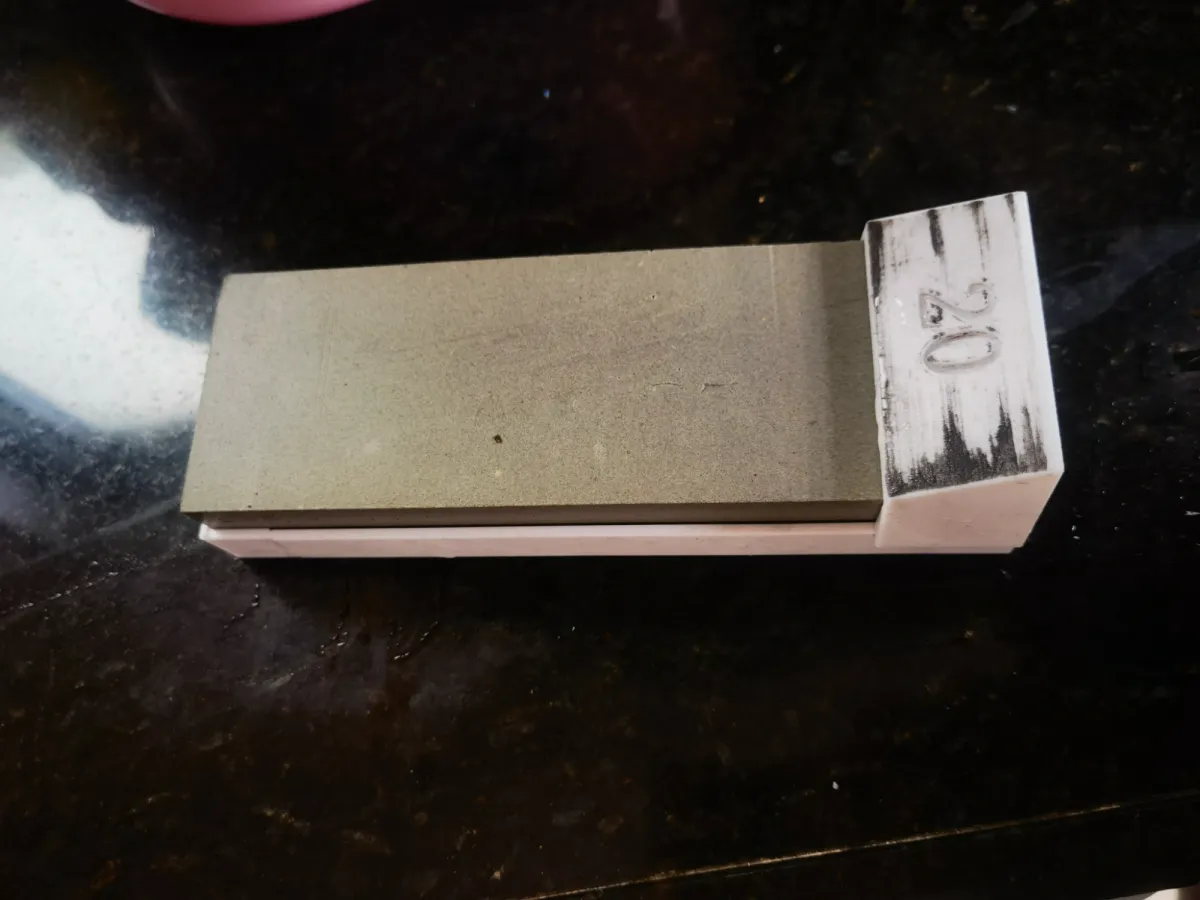



Sharpening Stone Box

- 0.2 mm layer height, 2‑wall walls, 15% infill density

1-disc
PETG
Designer

3

1
Base inner dimensions: 184 × 62 × 15 mm; total height: 30 mm
1. Definition of Blade Angles
- Single-Side Angle: Refers to the angle between one side of the blade and the sharpening stone. For example, if you sharpen each side at 20°, the total cutting edge angle will be 40°.
- Total Cutting Edge Angle: The sum of the angles on both sides, which directly influences the sharpness and durability of the blade.
2. Recommended Angle Ranges
- Chinese Chef’s Knives: Typically heavier and designed for handling bones or tough materials. We recommend a 20°–25° angle per side (totaling 40°–50°), striking a balance between sharpness and longevity.
- Western Chef’s Knives: Primarily used for slicing, these knives benefit from a 15°–20° angle per side (totaling 30°–40°), offering superior edge sharpness.
- Japanese Santoku Knives: Ideal for precision cutting, these knives often feature a 12°–15° angle per side (totaling 24°–30°). While the blade is exceptionally thin, it requires careful handling to maintain its edge.
3. Impact of Blade Angles
- Small Angles (e.g., below 15°): Blades are sharper but more prone to chipping or dulling quickly—best suited for soft ingredients.
- Large Angles (e.g., above 25°): Blades are more durable and better equipped to handle hard materials, though their sharpness is reduced.
4. Adjustment Recommendations
- Handling Hard Materials (such as bones): Increase the angle to a total of 40°–50°.
- Daily Slicing: Reduce the angle to a total of 30°–40° to enhance sharpness.
- Blade Material: High‑hardness steels like VG‑10 can withstand smaller angles; for standard steel, an intermediate angle is recommended.
5. Sharpening Techniques
- Maintain a Consistent Angle: Use a fixed-angle sharpening guide or hone your technique through practice.
- Grind in Stages: Start with coarse grinding to correct the blade’s shape, then move to fine grinding to polish the edge.
- Test Sharpness: Use paper or a tomato to verify even, consistent sharpness across the entire blade.
6. Tool Selection
- Sharpening Stones: Opt for dual‑sided stones—natural or synthetic—with varying grits, ideal for manually adjusting blade angles.
- Fixed-Angle Sharpening Guides: Perfect for beginners, ensuring consistent angles every time.
- Sharpening Rods: Quick and convenient for daily maintenance, perfect for touch‑ups and minor edge adjustments.
1. Basic Concepts of Grit
Grit: Indicates the coarseness of abrasive particles—higher grit numbers correspond to finer particles, resulting in smoother edges but reduced cutting power.
Low Grit (e.g., 200–800 grit): Coarse particles deliver strong cutting performance, ideal for repairing nicks or heavily worn blades.
High Grit (e.g., 3000 grit and above): Fine particles are used for polishing the blade edge, enhancing sharpness and smoothness.
2. Recommended Grit Levels for Different Applications
(1) Daily Maintenance (Minor Dulling)
Medium to High Grit (1000–3000 grit)
Start by using 1000‑grit to remove minor burrs, then follow up with 3000‑grit for a polished finish—perfect for quick home sharpening.
(2) Repairing Severe Wear or Nicks
Coarse Grinding Stage (200–800 grit)
Restore damaged edges or severely dulled blades, quickly reshaping the blade’s profile.
Medium Grinding Stage (1000–2000 grit)
Refine the blade edge, eliminating coarse grinding marks.
Finishing Grinding Stage (3000–6000 grit)
Polish the blade edge to achieve a razor‑sharp, pristine finish.
(3) Professional‑Grade Sharpness (e.g., Japanese Knives)
Ultra‑High Grit (8000–12000 grit)
For ultimate polish, ideal for sashimi knives or razors that demand mirror‑like edge precision.
3. Influence of Blade Material
Common Carbon Steel/Stainless Steel: A grit range of 1000–3000 is recommended, balancing efficiency with effective results.
High‑Hardness Steels (e.g., VG‑10, Powder Metallurgy Steel): Require higher grit levels (5000 grit and above) for fine polishing, helping to prevent edge chipping or cracking.
4. Practical Application Strategies
Home Economy Option: A dual‑sided sharpening stone (1000/3000 grit) meets everyday needs.
Professional‑Level Repair: Use a three‑stone set (400 grit + 1000 grit + 5000 grit) for staged sharpening.
Quick Maintenance: A ceramic sharpening rod (around 2000 grit) lets you touch up the blade edge anytime.
5. Operational Tips
Grind in Stages:
Coarse Grinding (200–800 grit) → Restore blade geometry
Medium Grinding (1000–2000 grit) → Refine the blade edge
Finishing Grinding (3000 grit and above) → Polish for maximum sharpness
Avoid Skipping Grits: Keep the stepwise progression within a 3‑fold range between adjacent grits (e.g., 400 → 1000 → 3000 grit).
Test Sharpness: After finishing grinding, test the blade with paper or a tomato to ensure even, consistent cutting performance.
6. Important Considerations
Soft Steel Blades (e.g., Chinese chef’s knives): No need for excessively high grits—3000 grit is usually sufficient; higher grits may lead to edge rolling.
Hard Steel Blades (e.g., Japanese kitchen knives): We recommend fine polishing at 5000 grit or higher to extend edge retention and maintain sharpness over time.
Don’t Jump Straight to High Grits: If the blade has significant nicks or damage, skipping the coarse grinding stage can result in inefficient sharpening.
Summary
Home Use: Start with 1000‑grit to repair the blade, followed by 3000‑grit for a polished finish.
Professional Repair: Grind in stages—400 grit → 1000 grit → 5000 grit.
Ultimate Sharpness: Achieve mirror‑like finishes with 8000 grit or higher—ideal for high‑hardness steels.
Originality of the Model
The author declares that this work is their personally original model
This model is licensed under the following terms:
Credit must be given to the creator
Models(1)
- 磨刀石盒子 v3.3mfDesigner

994.48 KB

2025-08-10


