



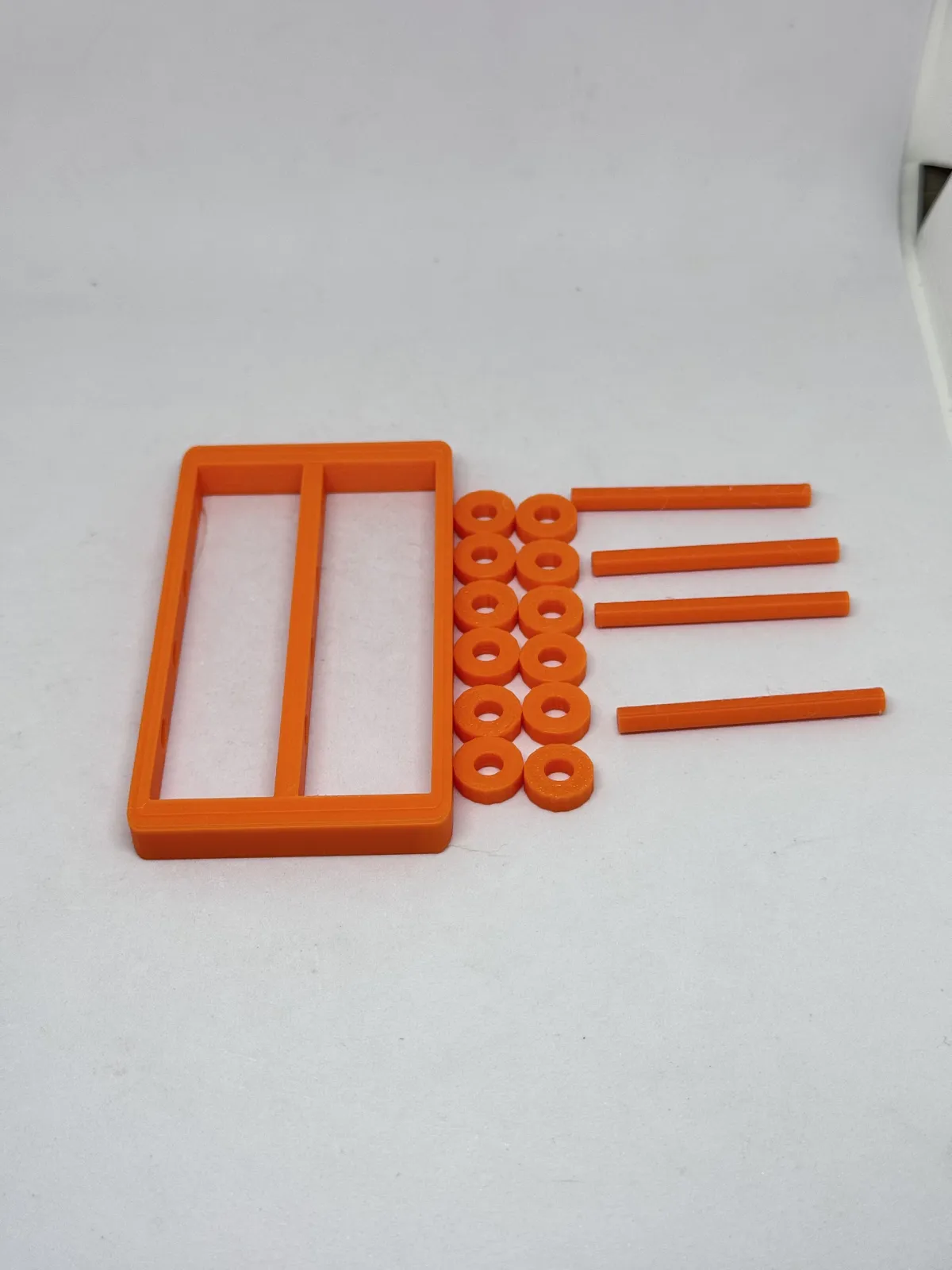


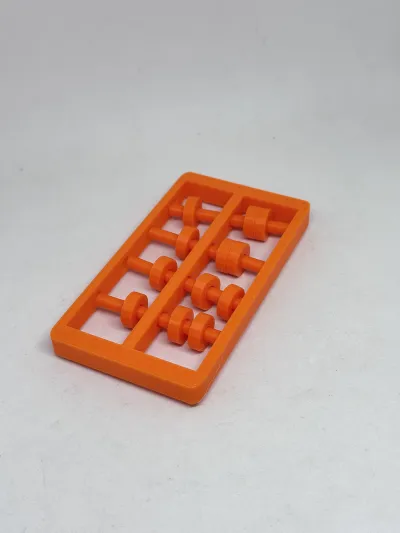

Abacus
Computer-aided tools

- 0.2 mm layer height, 2‑wall walls, 15% infill density

1-disc
PLA
Designer

4

0
The abacus is a manually operated computational aid that originated in China and represents an important ancient Chinese invention. The following is a detailed introduction to the abacus:
Historical Development: The history of the abacus can be traced back to the Han Dynasty, evolving gradually from counting rods. The term “abacus calculation” first appears in Xu Yue’s “Record of Mathematical Techniques” written during the Eastern Han Dynasty. By the late Tang Dynasty, multiplication and division methods had been refined. During the Song Dynasty, division mnemonics were developed, and abacus calculation gained a foothold in economic and commercial activities; for instance, the “Qingming Festival on the River” painting clearly depicts an abacus placed on the counter of the “Zhao Taicheng Family” pharmacy. In the Ming Dynasty, with the flourishing of the commercial economy, abacus arithmetic was widely promoted, gradually replacing counting rods and eventually spreading abroad.
Structure and Varieties: Abacuses are typically rectangular, consisting of a frame, a beam, dividers, and beads. Common types include the seven-bead large abacus, with two upper beads and five lower beads; the five-bead small abacus, featuring one upper bead above the beam and four lower beads below; and the six-bead small abacus, which also has five lower beads. In addition, there are abacuses from other countries, such as the Japanese abacus, where there is only one bead above the horizontal beam and the cross-section of each bead is diamond-shaped; and the Russian abacus, which lacks a central horizontal beam and has ten beads per divider.
Calculation Methods: Numbers are represented by beads, and place values are indicated by the dividers. When moving beads toward the beam, each lower bead counts as 1, each upper bead as 5, and an empty divider represents 0. Higher-order digits are on the left, while lower-order digits are on the right. Through specific mnemonic rules, operations such as addition, subtraction, multiplication, and division can be performed—for example, addition follows principles like aligning digits by place value and adding from the highest order to the lowest.
Cultural Value: In 2008 and 2013, abacus calculation was respectively inscribed on China’s National Intangible Cultural Heritage List and UNESCO’s Representative List of the Intangible Cultural Heritage of Humanity, underscoring the abacus’s significant cultural value.
Originality of the Model
The author declares that this work is their personally original model
This model is licensed under the following terms:
Credit must be given to the creator
Only noncommercial uses of the work are permitted
Models(1)
- 算盘1001.3mfDesigner

85.09 KB

2026-03-29


