



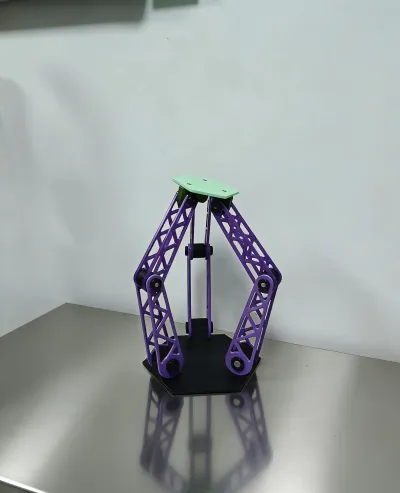

Robot
Parallel mechanism

- 0.2 mm layer height, 2‑wall walls, 15% infill density

6-disc
PLA
Designer

18

2
⭐Precise modeling using SolidWorks, with ample assembly clearances pre-allocated.
🚀Model Overview
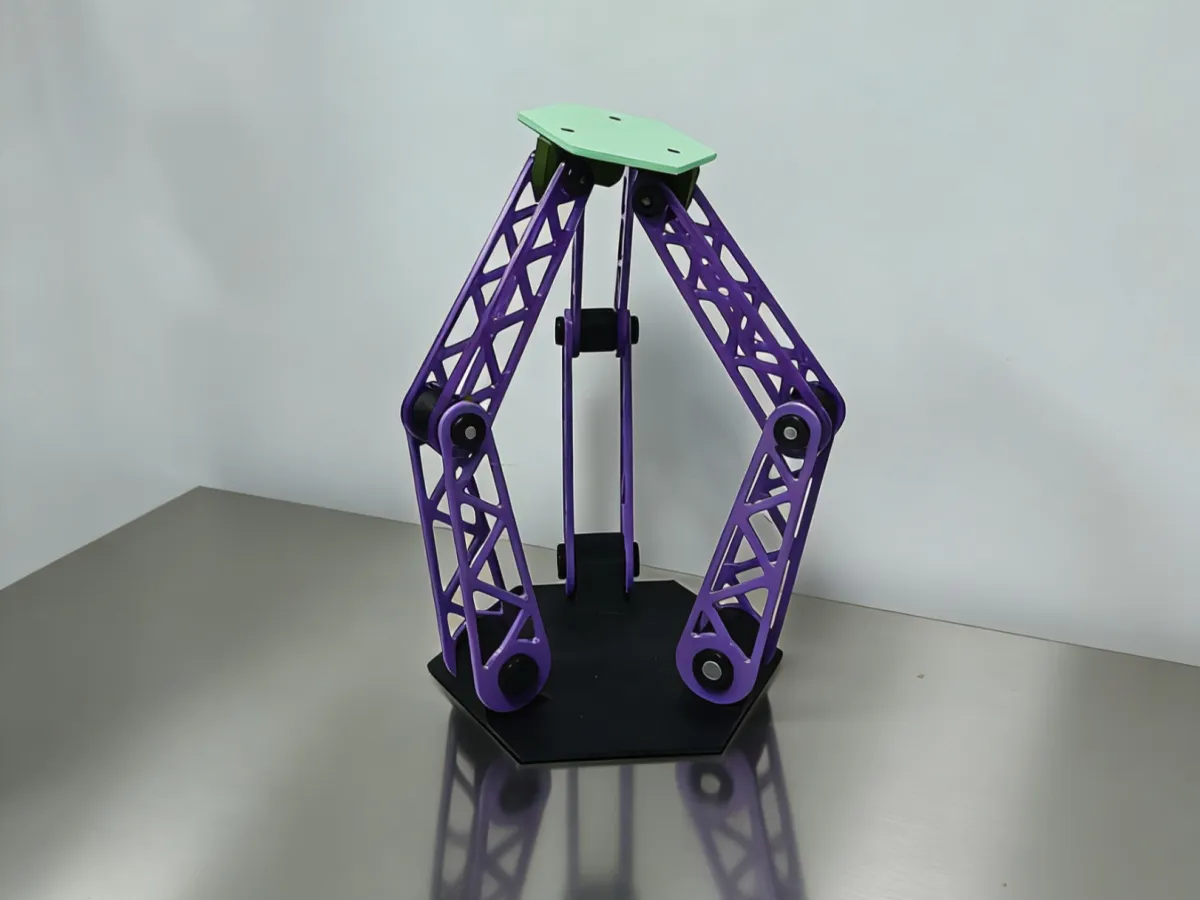
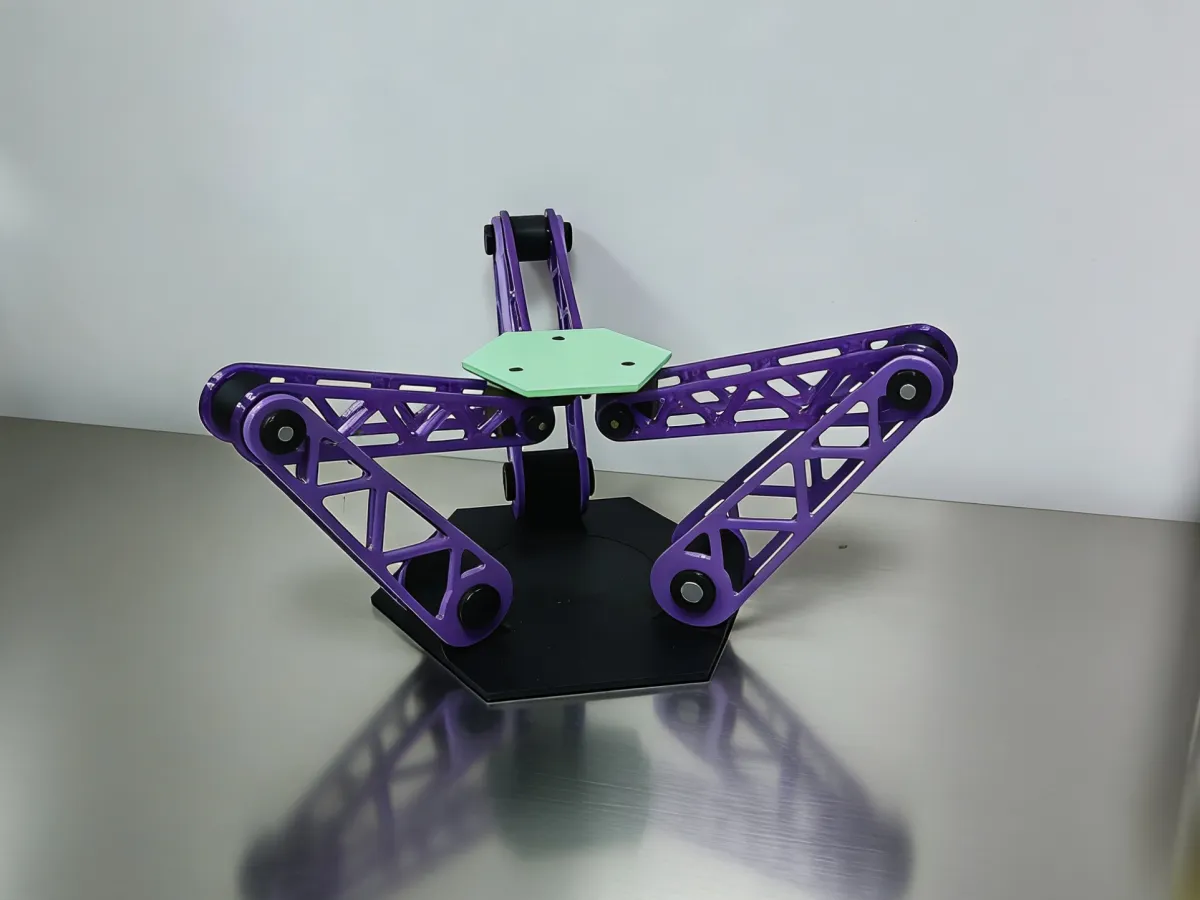
This model is a teaching demonstration unit built on the principles of classic low-degree-of-freedom spatial parallel mechanisms. Its configuration adheres strictly to kinematic design standards: it consists of upper and lower hexagonal moving and fixed platforms, paired with three perfectly symmetrical legs. Each leg features a series connection of two revolute joints (R) and one spherical joint (S), representing a classic core configuration in the field of parallel robots. The entire structure is 3D-printed as a single integrated unit, employing snap-fit pin-joint connections to replace traditional hardware fasteners such as bolts and bearings. By completely eliminating hardware components while fully preserving the mechanism’s core kinematic characteristics, this design achieves both lightweight construction and easy disassembly for demonstration purposes. It also faithfully reproduces the structural logic of the parallel mechanism at a 1:1 scale, providing a clearly structured and user-friendly physical platform for educational demonstrations.
From a kinematic standpoint, the 3-RRS parallel mechanism is a typical three-degree-of-freedom spatial mechanism, capable of linear motion along the Z-axis and two-dimensional rotation about the X- and Y-axes (i.e., a “1T2R” motion mode). Compared with serial mechanisms, parallel configurations inherently offer superior structural rigidity, higher motion accuracy, and greater load-carrying capacity—making them the core architecture for high-end equipment such as industrial precision machining systems and rehabilitation robots. As an educational tool, the primary value of this model lies in its ability to fully materialize abstract kinematic principles: learners can manually manipulate the moving platform to directly observe the coordinated motion of the three legs, experience firsthand the coupling effects of spatial movement, and gain a clear understanding of the fundamental logic behind how low-degree-of-freedom parallel mechanisms achieve specific motions through leg constraints. In doing so, it transforms theoretical calculations of degrees of freedom and kinematic analysis into tangible, hands-on experiences, significantly lowering the barrier to learning spatial kinematics and making complex theoretical concepts more accessible and intuitive.
Moreover, this hardware-free version of the 3-RRS model offers multiple extended educational benefits in teaching settings: its all-3D-printed, hardware-free structure allows learners to independently disassemble, reassemble, and fine-tune the mechanism, gaining an in-depth understanding of the constraint roles of each joint and developing practical skills in mechanism design and assembly. At the same time, the model accurately replicates the kinematic logic of industrial-grade 3-RRS mechanisms, enabling seamless integration with real-world industrial applications—such as precision machining of aerospace components or precise handling of LCD substrates—and helping learners establish a complete cognitive chain that links theory, model, and engineering practice. In addition, its symmetrical design and intuitively demonstrable motion characteristics make it an ideal core teaching aid for courses in mechanism theory and robotics, used to illustrate the principles of parallel mechanisms and compare the differences between serial and parallel architectures. With its combination of popular science appeal, pedagogical value, and demonstrative effectiveness, it serves as an ideal physical tool for teaching spatial mechanisms.
🚀Printing Recommendations
Most parts can be processed normally using the default print parameters.
Please calibrate overhang and bridge-building parameters in advance to ensure smooth assembly.
For the ball-joint components, be sure to calibrate the extrusion flow rate ratio and K-value in advance, and reduce the printing speed to prevent sticking. Additionally, this component uses dissimilar-material supports, so ensure a sufficiently high purge volume during material changes.
Originality of the Model
The author declares that this work is their personally original model
This model is licensed under the following terms:
This work is licensed under a Standard Digital File License. Digital files have a strict non-commercial, personal use only license.
You shall not share, sub-license, sell, rent, host, transfer, or distribute in any way the digital file or 3D printed versions of this object, nor any other derivative work of this object in its digital or physical format (including remixes of this object). You can not host these files on other digital platforms, web stores or cloud repositories. The objects may not be used in any way whatsoever in which you charge money, collect fees.
Models(1)
- 3-RRS机构 加工文件.3mfDesigner

1.64 MB

2026-04-02


