




Dinosaurs
Spinosaurus
Light
Atmosphere
Fierce
Predator
Cool!
Cool

- 0.2 mm layer height, 2-wall structure, 8% infill density

11-disc
PETG/PLA
Designer

48

4
Time: Early Cretaceous
Location: Somewhere along the shoreline of a lake in Egypt
The World of Dinosaurs.
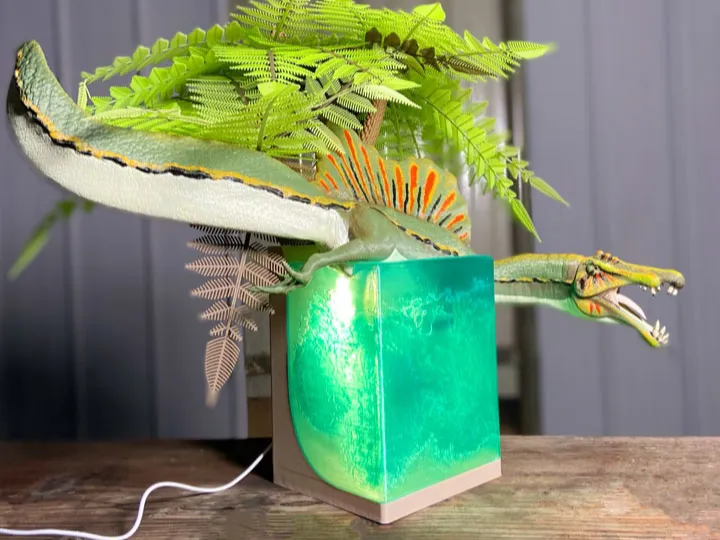
Several pterosaurs glide gracefully through the sky, while the air by the lake is humid and sweltering. A herd of Triceratops stands in a line along the open lakeshore, greedily drinking from the water. In the distance, a long-necked plesiosaur moves slowly toward the lake’s edge. Though this world appears calm and peaceful, it often harbors hidden dangers.
A dense canopy of cycad leaves rustles gently in the breeze, their fronds swaying ever so slightly. Hidden beneath the foliage, an Acrocanthosaurus watches the water’s surface—then, suddenly, a dark shadow darts across the murky depths. It’s Acrocanthosaurus’ prey, and with a silent, fluid motion, the predator slips into the water, its tail trailing effortlessly behind…
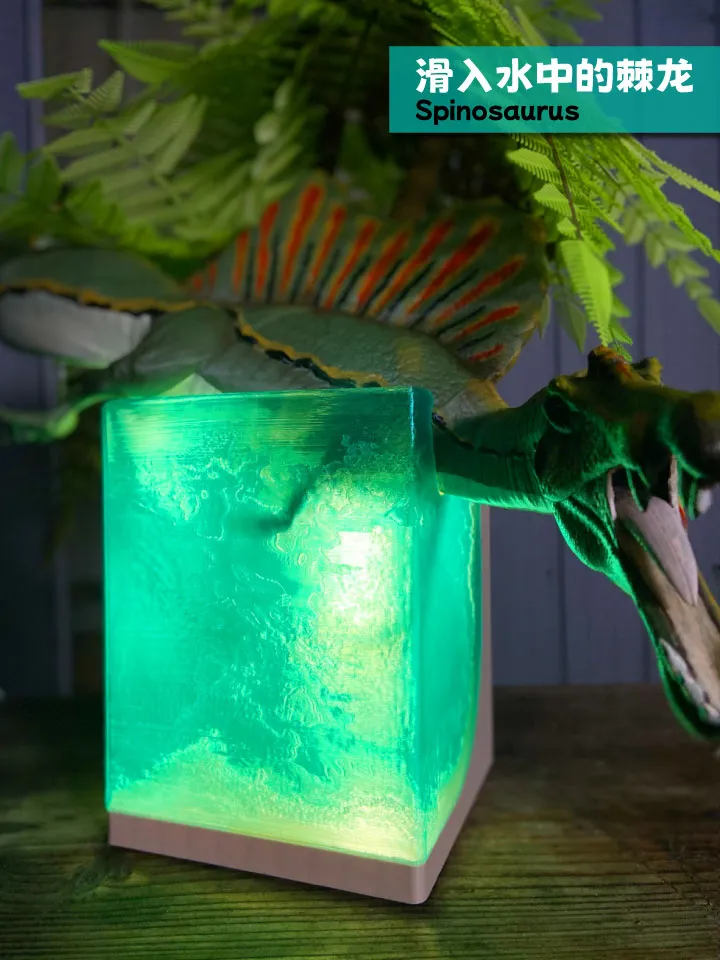
Based on this vision, I designed and 3D printed a conceptual model of Acrocanthosaurus, using Nomad and Shapr3D for modeling.
Acrocanthosaurus was a large carnivorous dinosaur that lived during the Cretaceous period, first discovered in Egypt. To date, 12 distinct species have been identified within the Acrocanthosauridae family.
Initially, paleontologists believed Acrocanthosaurus was a terrestrial dinosaur—much like the creatures depicted in “Jurassic Park.” However, newly discovered fossils have shifted the consensus toward the idea that these dinosaurs were actually aquatic. Excavated remains reveal that Acrocanthosaurus possessed a massive, laterally flattened tail that accounted for nearly half of its total body length—suggesting that it was far better adapted to life in the water, much like modern-day crocodiles.
My original concept was to design a standard, upright Acrocanthosaurus—but that felt too conventional. Besides, similar models could easily be found everywhere, lacking any truly innovative or distinctive flair.


After reviewing extensive research, I learned that recent studies suggest Acrocanthosaurus was more closely tied to an aquatic lifestyle. That’s when I got the idea to design Acrocanthosaurus as if it were swimming in the water—and with green, semi‑transparent PETG at hand, the storyline at the beginning of this article took shape.
However, a compelling narrative alone wasn’t enough; I needed to capture the right atmosphere to fully bring my vision to life. And so, I arrived at what I consider the most satisfying aspect of the piece: the shadows cast by Acrocanthosaurus beneath the water’s surface, and the sense of turbulence created as the dinosaur stirs up the murky depths!
Some Reflections:
To enhance the visual impact, I opted not to include splashes of water, allowing the overall theme to stand out more clearly—and aligning perfectly with the scenario of silently stalking prey from the shore.
I used a single light source to create backlighting, casting silhouettes of the dinosaur’s underwater limbs against the water’s surface. The semi‑transparency of PETG brought the murky depths to vivid life, capturing every subtle ripple and eddy.
With a brush, I carefully rendered water ripples on the back side of the water, adding depth and dimension to the effect of a disturbed, churning lakebed.
Notes:
Given the nature of FDM printing, the model benefits from additional coloring to achieve a more lifelike finish. You can draw inspiration from living reptiles—such as snakes or lizards—to guide your color choices. I used fabric dye; you might also experiment with acrylic paints—or, for even richer results, consider using model paint.
Since tolerances can vary, it’s essential to use adhesive. We recommend using PETG polish as a bonding agent.
The cycad leaves number 45 in total—feel free to adjust the quantity based on your preferences. If a few leaves break off during assembly, don’t worry—the natural world isn’t perfect either.
In nature, cycad leaves grow rapidly in a spiral pattern, so their size doesn’t vary dramatically. However, you can also choose to trim them progressively from bottom to top, according to your personal aesthetic—this approach adds a sense of growth and vitality to the final piece.
Use a lamp with a diameter no larger than 59.5 cm and a thickness of no more than 1 cm.
A Reasonable Assembly Sequence:
Clean all support surfaces thoroughly and ensure they’re smooth and level (for basic tips, refer to your preferred resources).
Start by painting the head and mouth.
Assemble the body, tail, and limbs.
Attach the head to the neck.
Design and paint the model—depending on the desired finish, you may need 2–3 coats to fully cover the base color.
Install the shorter branches on the shorter stems, and the longer branches on the longer stems—pay attention to the direction of growth, as incorrect placement can result in unnatural angles. Then, starting from the bottom, attach the leaves, placing the brown leaves at the very bottom.
Secure the water to the lamp base, then mount the tree onto the top surface of the lamp base.
Install the small nightlight—no adhesive required.
Place the painted dinosaur head facing right, floating on the surface of the water.
Turn on the light and enjoy your finished creation.
Bill of materials
- NameQuantityNotes
- 1灯1某竹上的kit001即可
Originality of the Model
The author declares that this work is their personally original model
This model is licensed under the following terms:
This work is licensed under a Standard Digital File License. Digital files have a strict non-commercial, personal use only license.
You shall not share, sub-license, sell, rent, host, transfer, or distribute in any way the digital file or 3D printed versions of this object, nor any other derivative work of this object in its digital or physical format (including remixes of this object). You can not host these files on other digital platforms, web stores or cloud repositories. The objects may not be used in any way whatsoever in which you charge money, collect fees.
Models(1)
- 棘龙-A1mini.3mfDesigner

27.20 MB

2025-08-09


