




Brushless motor
DIY motor kit
Axial Flux Motor
Maker Experiment

- 0.2 mm layer height, 4‑layer walls, 15% infill density

2-disc
PLA
Designer

9

0
DIY Brushless Motor Stator Housing Kit
I. Structure and 3D-Printed Components Explained
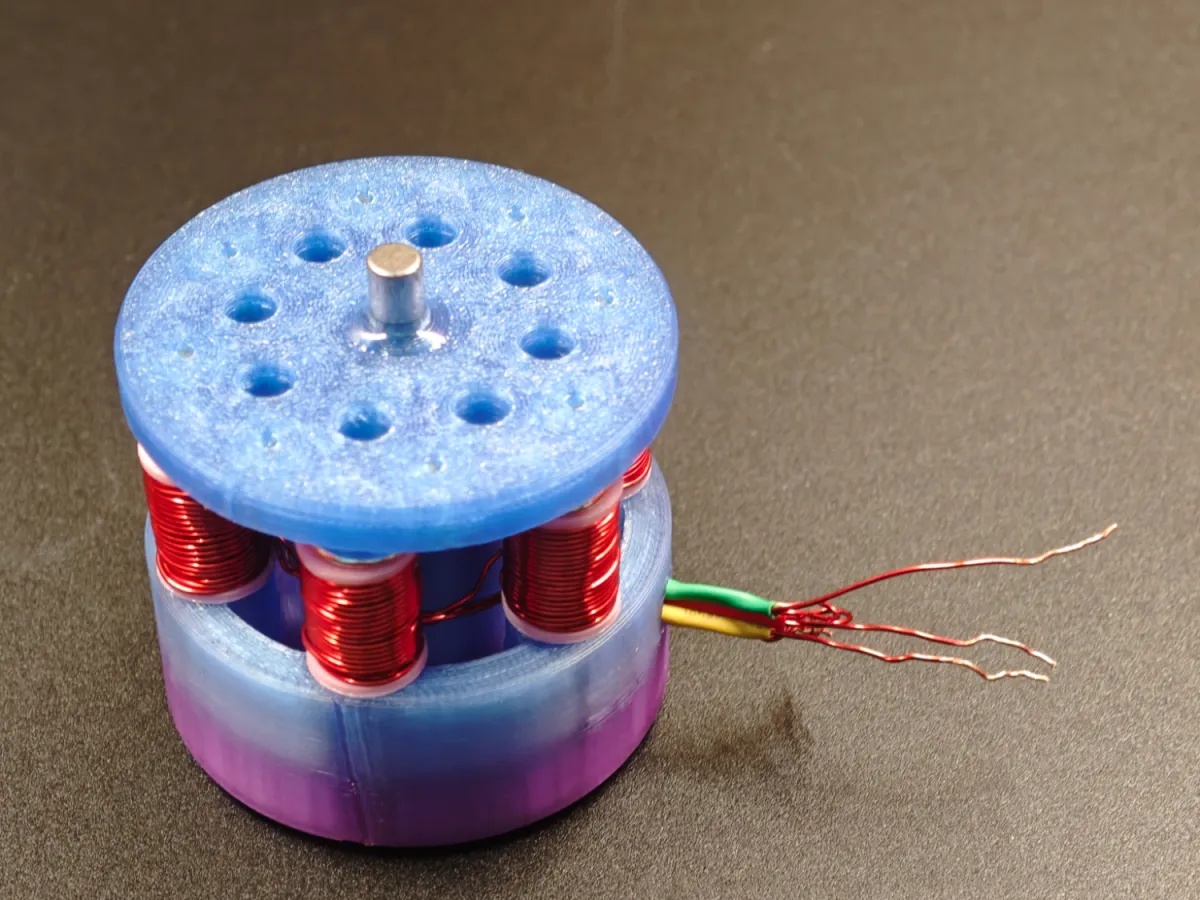
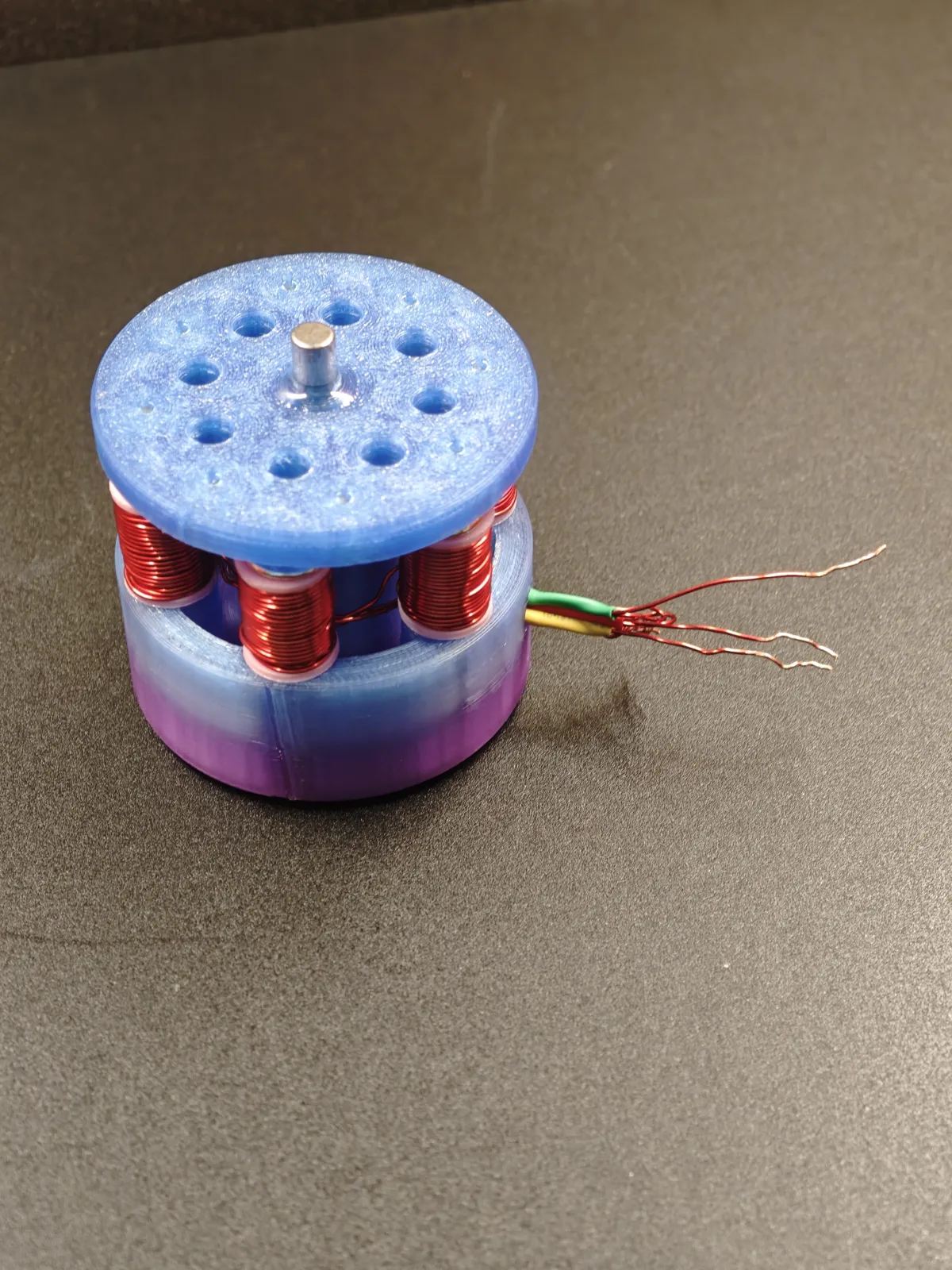
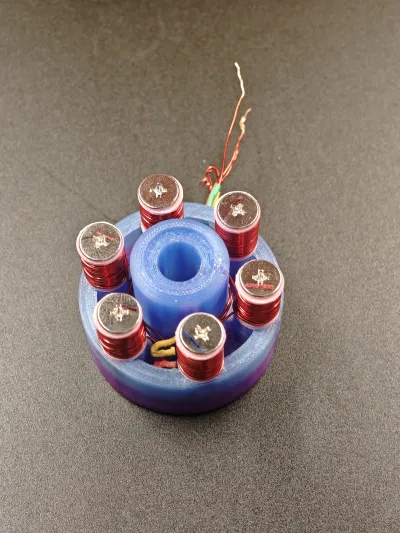
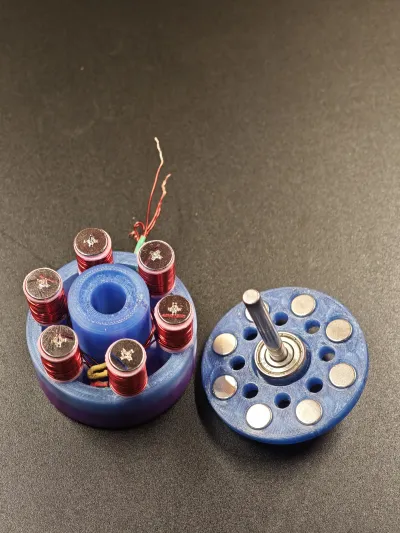
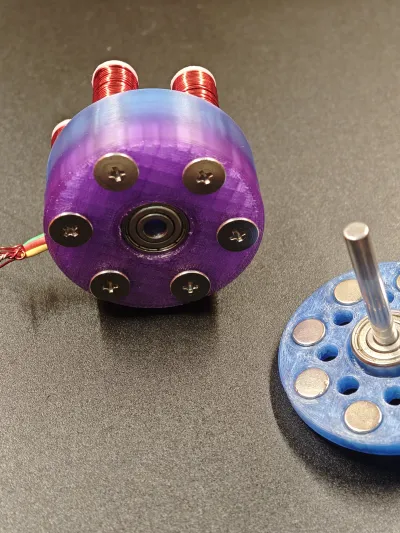
This is a DIY axial-flux brushless motor, with the housing and coil frame (bobbin holder) entirely fabricated via 3D printing. It features a metal iron-core shaft, enameled copper windings, and built-in permanent magnets, forming a complete motor assembly:
The white main housing—FDM‑printed—is a double-layered circular base with multiple evenly spaced mounting posts pre‑molded to secure the coil frame. The overall structure is a closed circular base that precisely divides winding positions, ensuring symmetrical coil arrangement and uniform magnetic fields. Reinforced edges enhance structural rigidity, preventing deformation under high-speed rotation.
The pink coil‑winding frame (bobbin stoppers, also 3D‑printed) includes two circular limit plates per winding group, creating independent winding slots:
These plates confine the enameled copper wire’s winding range, preventing untidy coils or short circuits.
A central metal iron core passes through the frame, serving as the magnetic flux path.
Multiple frames are arranged in a uniform ring, forming the motor stator armature.
Core Electrical Components
Enameled copper wire: wound around the frame to form excitation coils; when energized, it generates an alternating magnetic field.
Metal iron core: enhances magnetic conductivity and amplifies the coil’s magnetic field strength.
Built-in permanent magnets (hidden within the upper and lower white discs): provide the rotor’s magnetic field, interacting with the stator coils to produce rotation.
II. Key Features of the 3D Printing Process
Modular, split‑piece printing reduces complexity: the housing base and upper/lower bobbin holders are printed separately, avoiding large overhangs and requiring virtually no supports throughout the process. A standard desktop FDM printer can handle this task, eliminating the need for complex monolithic prints. Damaged parts can be replaced individually, making maintenance straightforward.
Dimensional Accuracy Matches DIY Winding Needs: The post spacing and internal bore tolerances of the frame are tightly controlled, allowing the metal iron core to fit snugly. Uniform slot heights ensure consistent coil turns and volume across all groups, guaranteeing balanced power output without magnetic bias or vibration.
Material Selection Tailored to Electrical Applications
PLA (white/pink versions shown here): ideal for static demonstrations and low‑speed applications due to its excellent insulation and low printing cost. However, it lacks heat resistance and may soften under high‑power thermal conditions.
PETG (recommended for long‑term motor use): superior heat resistance and toughness, maintaining coil shape even under thermal stress while providing stable insulation.
Insulation‑enhanced filaments: further improve inter‑coil insulation, reducing leakage and eddy current interference.
Integrated Base Simplifies Assembly: The lower disc consolidates all iron‑core mounting points, allowing the completed coil frame to simply slide onto the metal shaft and lock into place. This streamlined assembly process makes it accessible even for beginners.
III. Operating Principle and Core Applications
1. Basic Principle (Axial‑Flux Brushless Motor)
Multiple stator coils arranged in a ring are energized by three‑phase AC current, generating a rotating magnetic field. Permanent magnet rotors housed in the upper and lower discs interact with this field, driving continuous rotation without carbon‑brush friction. This design offers longer lifespan and reduced noise.
2. Primary Use Cases
Educational Demonstrations: Most commonly used in physics classes at primary and secondary schools or universities to illustrate electromagnetic induction and brushless motor operation. Ideal for classroom teaching and maker‑club workshops, offering hands‑on opportunities to disassemble and examine coils, permanent magnets, and stator components—far more instructive than sealed commercial motors.
DIY Power Projects: Suitable for modifying small devices such as miniature wind turbines, portable fans, model cars, low‑speed drone propulsion systems, or tabletop micro‑generation setups. By adjusting coil turn counts, voltage and rotational speed can be fine‑tuned, making it perfect for electromagnetic hobbyists conducting experiments.
Handcrafted Electromagnetic Creations: Enables building small generators, magnetic pendulum ornaments, kinetic lighting fixtures, and other projects. When paired with a rectifier module, these creations can generate electricity to power LEDs.
Bill of materials
- NameQuantityNotes
- 1磁铁8MM*3MM8
- 2M5*35 铁镀镍子母螺丝6
- 3漆包线0.5mm15
Originality of the Model
The author declares that this work is their personally original model
This model is licensed under the following terms:
Credit must be given to the creator
Models(1)
- 轴向磁通电机.3mfDesigner

659.87 KB

2026-06-30


