




DJI Air 3s

- 0.2 mm layer height, 2‑wall walls, 15% infill density

1-disc
PLA
Designer

9

1
Soaring to New Heights: The DJI Air 3S Redefines the Possibilities of Consumer‑Grade Drones
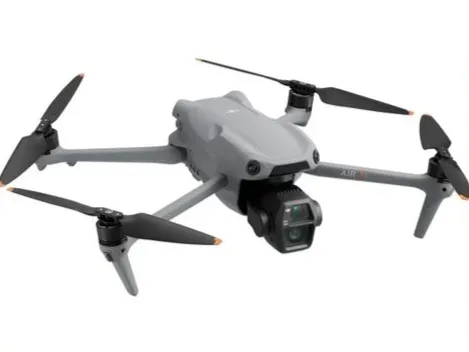
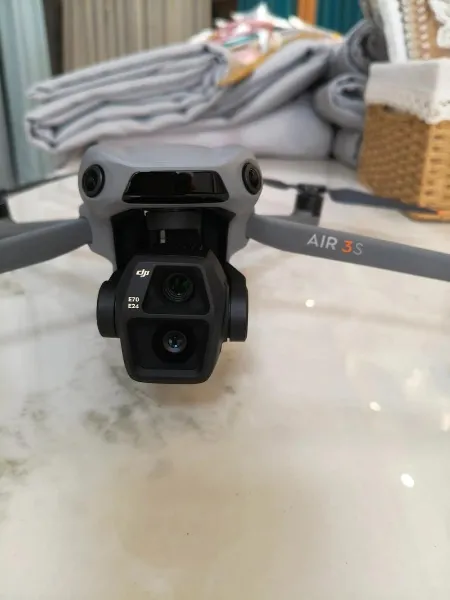
As morning light breaks through the clouds and bathes the earth, a silver‑gray flying device gracefully slices across the sky, its dual‑camera system simultaneously capturing both the sweeping grandeur of wide‑angle views and the intricate details of medium‑telephoto shots. This isn’t a scene from a science fiction film—it’s the everyday creative experience brought to modern creators by DJI’s latest masterpiece, the Air 3S. As a game‑changer in the consumer drone space, the Air 3S not only carries forward the essence of DJI’s Mavic series but also packs professional aerial‑photography capabilities into a compact, portable body weighing just 720 grams, fundamentally redefining performance standards for lightweight drones.
I. Dual‑Camera Synergy: Reimagining the Aerial Perspective
The most striking innovation of the Air 3S lies in its unique dual‑camera setup: a 1/1.3‑inch CMOS wide‑angle main camera paired with a 1/1.5‑inch CMOS 3× medium‑telephoto lens, breaking free from the limitations of single‑viewpoint consumer drones. The wide‑angle lens maintains a 24mm equivalent focal length and features an f/1.7 large aperture, with individual pixel sizes reaching 2.4μm; in low‑light conditions, it can combine four pixels into one for superior noise reduction. Meanwhile, the newly added 70mm medium‑telephoto lens adopts an innovative f/2.4 aperture design, working seamlessly with advanced algorithms to enable dramatic spatial compression in aerial compositions.
This dual‑focal‑length configuration isn’t merely additive—it achieves a “1+1>2” effect through deep collaborative processing. In intelligent mode, the dual cameras can simultaneously record 4K video at 60fps, providing multi‑angle footage for post‑production. For professional creators, users can switch between perspectives in real time; the 70mm lens is particularly well suited for capturing architectural details, wildlife, or other subjects requiring safe shooting distances. Testing shows that the medium‑telephoto lens delivers 300% improved resolution compared to previous digital zooms—even when zoomed up to 6× hybrid (equivalent to 168mm), image quality remains usable, completely transforming the paradigm of mid‑range aerial photography.
II. Imaging System: An Aerial Revolution in Computational Photography
The Air 3S is equipped with DJI’s latest imaging processor, effectively serving as an “aerial supercomputer.” Its tri‑core heterogeneous architecture handles dual 4K video streams concurrently while running cutting‑edge algorithmic matrices in real time. The D‑Log M color profile captures 10‑bit depth with a dynamic range of 12.8 stops, and when combined with upgraded intelligent noise‑reduction algorithms, it preserves rich tonal nuances even during sunset scenes. Measured data indicates that its high‑ISO performance has improved by two ISO stops compared to the previous generation, significantly enhancing image clarity under similar lighting conditions.
Nighttime shooting capabilities have also seen breakthrough progress. The newly developed “Starlight Mode” employs multi‑frame synthesis to deliver low‑noise 1080p video even in moonlit conditions, while the “Trajectory Time‑Lapse” feature now supports synchronized dual‑camera recording, enabling dynamic time‑lapse sequences with parallax effects. Remarkably, all these professional functions are accessible via a streamlined UI, making sophisticated creative workflows within reach.
III. Flight Performance: An Intelligent Platform That Pushes Physical Limits
In terms of propulsion, the Air 3S features a redesigned aerodynamic architecture, with newly engineered propellers boosting efficiency by 15%. Paired with a 9,800rpm brushless motor, it maintains stable hovering at altitudes up to 5,000 meters. Its maximum horizontal speed reaches 21 m/s (75.6 km/h), accelerating from 0 to 100 km/h in just 3.9 seconds—response times comparable to those of professional racing drones. Even more impressive is that despite this performance boost, noise levels have been reduced by 10%, with ground‑level sound pressure measured at only 36 dB when flying at 120 meters.
Battery life sets a new benchmark. The smart flight battery capacity has increased to 4,200mAh, delivering up to 34 minutes of hover time in windless conditions, with an actual combined flight endurance of approximately 28 minutes. Coupled with a newly designed 100W fast charger, a full charge can be achieved in just 30 minutes, dramatically improving operational efficiency. The O3+ transmission system extends the maximum communication range to 15 kilometers (FCC standard), supporting real‑time 1080p/60fps video streaming with latency as low as 120 milliseconds, ensuring reliable long‑distance shooting.
IV. Intelligent Evolution: Redefining the Logic of Aerial Interaction
The Air 3S’s smart features go beyond mere assistance, evolving into true “creative partners.” The upgraded APAS 5.0 (Advanced Pilot Assistance System) constructs three‑dimensional environmental maps in real time, increasing obstacle‑avoidance accuracy to 95%—even when dealing with fast‑moving birds, it responds promptly. The newly introduced “Master Shot” mode offers 12 professional camera‑movement presets; users simply frame their subject, and the drone autonomously executes complex maneuvers like circling or diving, intelligently editing the footage on the fly.
Even more revolutionary is its AI tracking algorithm. The next‑generation Smart Track 5.0 not only boasts higher recognition precision but can also predict target trajectories, maintaining perfect composition even when following high‑speed activities such as skiing or cycling. In testing, its success rate in tracking sudden direction changes reached an astonishing 98%, far surpassing industry averages. Meanwhile, the “Focus Lock” function allows users to designate a specific point of interest, enabling the drone to autonomously adjust its position during flight to keep the subject perfectly centered in the frame.
V. Design Philosophy: The Pinnacle of Technological Aesthetics
The Air 3S’s industrial design embodies DJI’s enduring philosophy of “form follows function.” When folded, its compact body measures just 180×97×84 mm—roughly the size of a water bottle—yet houses remarkable technological density. A magnesium alloy frame reduces weight by 30% while enhancing structural strength, and a specially coated composite shell provides IP43 splash resistance. Its pioneering “Eagle Wing” folding mechanism has undergone 20,000 opening/closing cycles, ensuring long‑term reliability.
The human‑machine interface has also been meticulously refined. A redesigned cooling airflow lowers core component temperatures by 8°C, eliminating performance drops during extended operations; a triple‑mode GPS system—comprising GPS, GLONASS, and Galileo—maintains centimeter‑level positioning accuracy even in urban canyon environments. Even minor details, such as the SD card slot’s placement, have been optimized to support hot‑swapping without powering down, reflecting a deep understanding of creators’ workflows.
VI. Ecosystem Collaboration: Key Pieces in Building a Creative Closed Loop
The Air 3S is no longer an isolated flying platform—it serves as a central node within DJI’s broader creative ecosystem. It integrates seamlessly with the DJI RC‑N2 remote controller, featuring a bright 7‑inch display that remains clear even under intense sunlight; the addition of Wi‑Fi 6 connectivity enables simultaneous broadcast to multiple devices, streamlining team collaboration. With updates to the DJI Fly app, users can now perform advanced post‑production tasks—such as LUT color grading and intelligent editing—directly on their mobile devices.
Of particular note is its interoperability with Ronin stabilizers. Via Bluetooth 5.2, the Air 3S can function as an “aerial camera rig,” forming a multi‑perspective shooting system alongside ground‑based stabilizers. All devices synchronize timecode during recording, greatly simplifying multi‑camera production workflows. For professional users, DJASS2 (DJI Aviation Software Suite 2.0) offers a comprehensive solution for managing aerial photography data, standardizing everything from flight planning to asset archiving.
Standing at a pivotal moment in the evolution of consumer drones, the Air 3S has redrawn industry benchmarks with its extraordinary technological density. Far from being a simple iteration or feature dump, it strikes a golden balance between portability and professionalism by precisely addressing creators’ real needs. As this flying device unfurls its propellers and ascends, it carries not only optical sensors and processors but also a whole new dimension of how humanity observes the world—higher, farther, clearer, yet lighter, smarter, and more accessible. In an era where everyone is a creator, the DJI Air 3S is quietly rewriting the grammar of visual storytelling, ensuring that every spark of inspiration finds its own sky.
Originality of the Model
The author declares that this work is their personally original model
This model is licensed under the following terms:
Credit must be given to the creator
Remixes must be shared under the same license
Models(1)
- Dji Air3s.3mfDesigner

7.23 MB

2026-07-23


