




World Cup Model Design Challenge Ⅰ
Toys
Football
Board Games
Football Field

- 0.2 mm layer height, 2‑wall walls, 20% infill density

6-disc
PETG
Designer

181

42
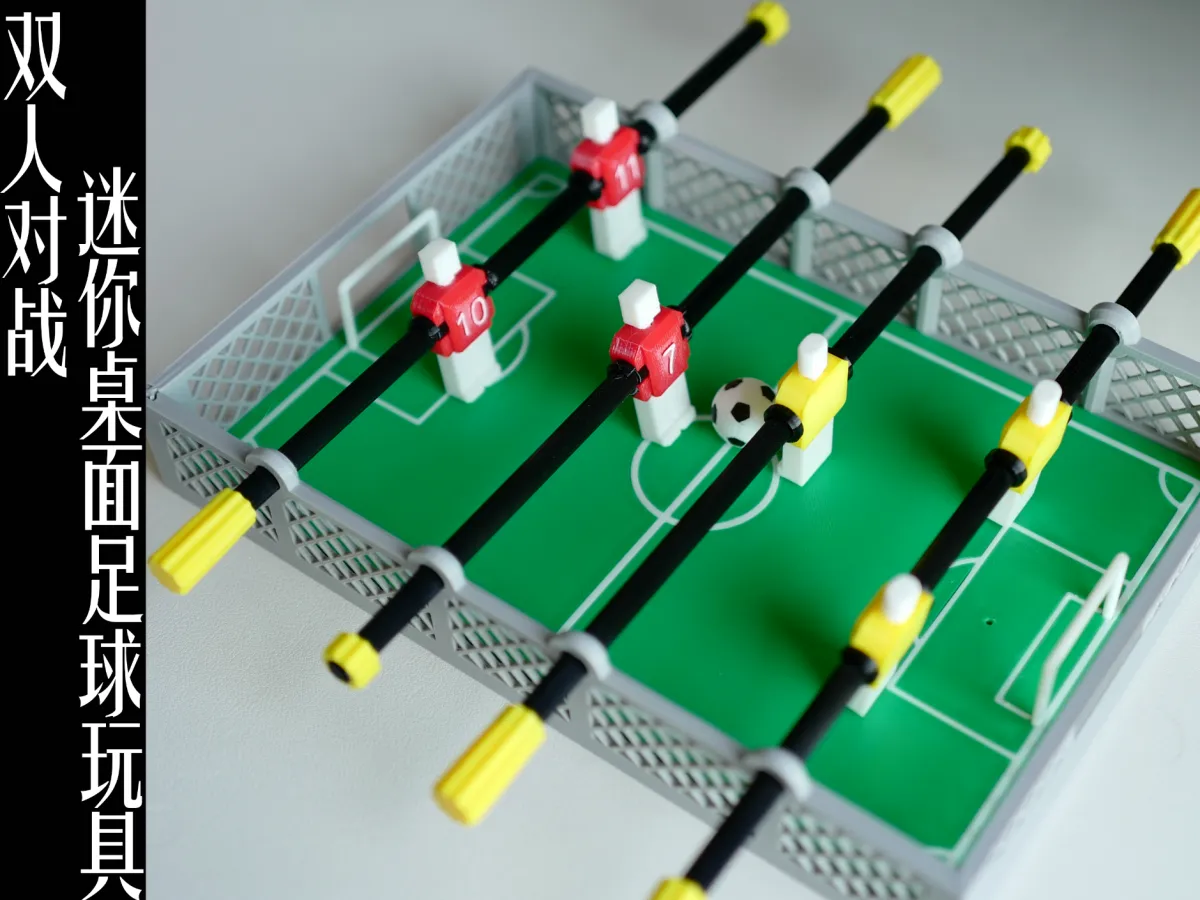
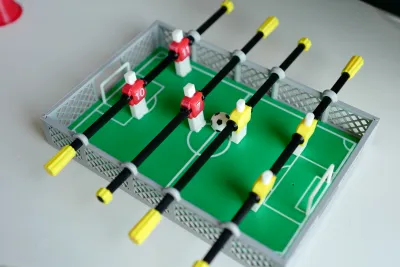
This is my fully 3D-printed, two-player mini table soccer (foosball) toy, which takes the classic tabletop game as its prototype and employs a modular design, multi-color printing, and meticulous detail reproduction to create a desktop micro-scale interactive device that combines playability, visual appeal, and DIY potential.
It is a lightweight, portable, and easy-to-use interactive stress-relief toy, specifically designed for desktop use. Its compact size saves space, making it suitable both as a solo stress-relief display piece and as a two-player competitive game. At the same time, it serves as a creative showcase of 3D printing’s modular design capabilities.
Highly faithful gameplay: It fully replicates the core competitive logic of table soccer, featuring a four-rod structure with complete offensive and defensive configurations.
User-friendly manufacturing process: The design uses separate parts and multi-color printing, eliminating the need for complex support structures. Standard PLA or PETG filaments can achieve multi-color effects without requiring additional painting.
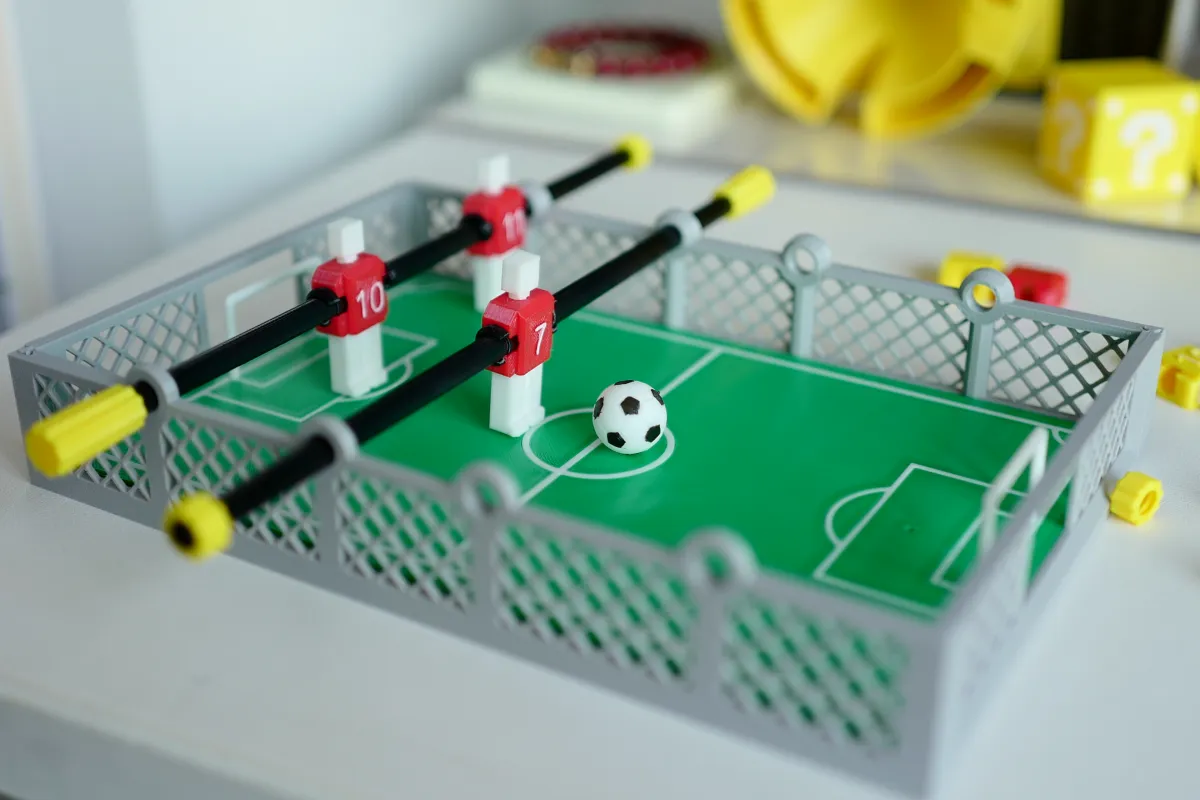
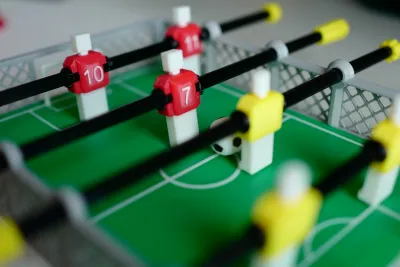
Rich in detail and atmosphere: From the field markings and player identifiers to the guardrails and goalposts, every element captures both realism and aesthetic design.
Highly expandable: The modular structure allows for personalized modifications down the line, making it an “open-ended design” that can be continuously iterated.
Field surface: Printed in green PLA, the surface features standard white markings typical of a soccer field—center circle, penalty area lines, and goal lines—simulating the texture of real grass. The black-and-white mini soccer balls are precisely scaled to match the field dimensions, ensuring smooth rolling.
Guardrail structure: A gray hollow-grid guardrail that not only recreates the visual effect of a stadium fence but also reduces material usage and overall weight through its open design. At the same time, it effectively prevents the balls from flying off the field during play, balancing aesthetics with practicality.
Goal components: Independently printed white mini goals that faithfully replicate the shape of real goals. Once installed, they fit perfectly with the field and guardrails, enhancing the sense of immersion in the scene.
Complete four-rod configuration: A total of four black rods, each paired with a yellow non-slip handle at both ends, enabling two-player competition. Each rod corresponds to a specific offensive or defensive position, forming a complete offensive–midfield–defensive system.
Bearing-mounted design: The rods are secured to the guardrails via gray mounting brackets, ensuring smooth pushing, pulling, and rotation while minimizing rod wobble. This enhances the feel of the game and improves durability.
Customizable player figures: A blank figure is provided for users to customize with their own numbers.
Red team players: Red jerseys marked with the numbers 7, 10, and 11, paired with white bases, representing the offensive/midfield side. The numerical markings reinforce a sense of identity and add design detail.
Yellow team players: Yellow jerseys paired with white bases, representing the defensive side. This clear color-coded distinction between teams makes the competition instantly recognizable.
Multicolor printing solution: Using red, yellow, black, white, gray, and green PLA filaments for separate part printing, the design achieves distinct color zones without post-processing painting. Different colors are also used to differentiate teams and functional components, creating a clear visual hierarchy.
Modular printing logic: Players, handles, rods, guardrails, and goals are all independent components that can be printed and replaced separately. This reduces the risk of failure for individual parts and leaves ample room for future personalized modifications.
Two-player competitive interaction: Two players each control the red and yellow rods, using push-and-pull motions to move their respective players, simulating real soccer shots and defenses. It’s an easy-to-learn, highly interactive desktop social tool that’s perfect for friend gatherings or casual leisure time.
Solo stress-relief play: Players can operate the rods on their own to control the ball and simulate shooting, passing the time while enjoying the smooth handling of the rods, which also has a relaxing, stress-relieving effect.
Desktop miniature decoration: With its exquisite design and color scheme, even when not in use, this piece makes a great desktop ornament—a uniquely personal, creative display that highlights your design skills and 3D printing expertise.
Parent–child interactive tool: Even young children can easily get started, developing hand–eye coordination while experiencing the fun of soccer through play. It’s a screen-free option for parent–child interaction.
The assembly steps are relatively simple, requiring only glue and no additional metal parts. Be sure to clean small parts or apply glue to prevent failures. All components are printed in PETG.
| First, prepare all the printed parts and a bottle of glue. |  |
| Next, glue the body, legs, and head of the figurines. The blank figurine’s body number can be customized. |  |
| Then assemble the guardrails, making sure the flat bottom of the front and back panels faces inward. |  
|
| Next, assemble the playing field: simply snap the white line portion into place and press it flat (tolerance has already been accounted for). Glue can be used to secure it. Then place the field inside the guardrails and use glue to attach the protruding side panels to the bottom of the field. |   |
| Finally, assemble the figurines and the movable rods. First, glue one side of the movable rod’s handle to the rod, then thread the figurine through the hole in the side panel guardrail. Note that there are two styles of connecting rods—one for two-player use and one for single-player use—so be sure to distinguish them. After that, secure the figurine on both sides with snap-fit connectors. |    |
| At this point, you can switch to single-player mode; simply repeat the installation process on the other side, and once both sides are assembled, you’re ready to play. |   |
| Installation complete. The finished product is smaller than an A4 sheet of paper, making it easy to store. Other round balls can be used instead of soccer balls. |  |
Originality of the Model
The author declares that this work is their personally original model
This model is licensed under the following terms:
This work is licensed under a Standard Digital File License. Digital files have a strict non-commercial, personal use only license.
You shall not share, sub-license, sell, rent, host, transfer, or distribute in any way the digital file or 3D printed versions of this object, nor any other derivative work of this object in its digital or physical format (including remixes of this object). You can not host these files on other digital platforms, web stores or cloud repositories. The objects may not be used in any way whatsoever in which you charge money, collect fees.
Models(1)
- 迷你三人足球桌面对战玩具.3mfDesigner

1.31 MB

2026-05-10


