




education
learning
academy
Viking
Ghost Archipelago
History
MakerBot
Travel
wooden longship


11

1
Summary
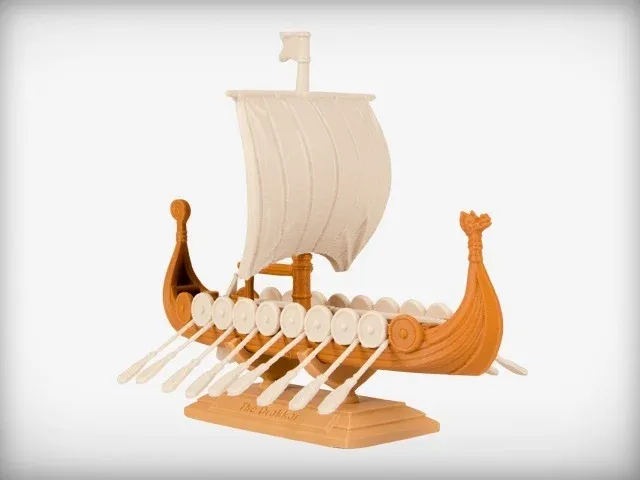
Travel back to the early 1000’s and jump aboard The Drakkar with Captain Leif Erikson. Believed to be the first European to set foot on the shores of North America, Erikson sailed this type of wooden longship often found with an animal or dragon head carved into its prow.
With the intent of making the 3D printing ecosystem more accessible to educators,
MakerBot Academy has selected Common Core Standards for English Language Arts and Mathematics that align with our 3D printed content. Our goal is to lower the barrier to 3D printing in the classroom by directing teachers to standards-aligned resources. We hope to make the process of incorporating 3D printing technology into the curricula more
seamless for teachers and students alike. Find these resources in the "Instructions" tab.
Print Settings
Supports:
No
Post-Printing
Instructions
FAMOUS EXPEDITIONS
==
Resources & Common Core Standard Alignments
MakerBot Academy encourages you to incorporate MakerBot’s 3D printed ships and their explorers into your lessons.
Ship: The Bao Chuan, Explorer: Zheng He
Ship: The Drakkar, Explorer: Leif Erikkson
Ship: The Endeavour, Explorer: James Cook
Ship: The Sao Cristovao, Explorer: Bartolomeu Dias
Ship: The Trinidad, Explorer: Ferdinand Magellan
MATHEMATICS
4th Grade:
Lesson Suggestion: Western Upper Peninsula Center for Science, Mathematics and Environmental Education
Common Core Standard Alignments:
Measurements & Data: Solve problems involving measurements and conversion of measurements
CCSS.Math.Content.4.MD.A.1
Know relative sizes of measurement units within one system of units including km, m, cm; kg, g; lb, oz.; l, ml; hr, min, sec. Within a single system of measurement, express measurements in a larger unit in terms of a smaller unit. Record measurement
equivalents in a two-column table. For example, know that 1 ft is 12 times as long as 1 in. Express the length of a 4 ft snake as 48 in. Generate a conversion table for feet and inches listing the number pairs (1, 12), (2, 24), (3, 36), ...
CCSS.Math.Content.4.MD.A.2
Use the four operations to solve word problems involving distances, intervals of time, liquid volumes, masses of objects, and money, including problems involving simple fractions or decimals, and problems that require expressing measurements given in a larger unit in terms of a smaller unit. Represent measurement quantities using diagrams such as number line diagrams that feature a measurement scale.
CCSS.Math.Content.4.MD.A.3
Apply the area and perimeter formulas for rectangles in real world and mathematical problems. For example, find the width of a rectangular room given the area of the flooring and the length, by viewing the area formula as a multiplication equation with an unknown factor.
7th Grade:
Lesson Suggestion: The Institute of Navigation
Common Core Standard Alignments:
Geometry: Draw construct, and describe geometrical figures and describe the relationships between them
CCSS.Math.Content.7.G.A.1
Solve problems involving scale drawings of geometric figures, including computing actual lengths and areas from a scale
drawing and reproducing a scale drawing at a different scale.
CCSS.Math.Content.7.G.A.2
Draw (freehand, with ruler and protractor, and with technology) geometric shapes with given conditions. Focus on constructing triangles from three measures of angles or sides, noticing when the conditions determine a unique triangle, more than one
triangle, or no triangle.
CCSS.Math.Content.7.G.A.3
Describe the two-dimensional figures that result from slicing three-dimensional figures, as in plane sections of right rectangular prisms and right rectangular pyramids.
11th Grade:
Lesson Suggestion: Western Upper Peninsula Center for Science, Mathematics and Environmental Education 2011, Western Upper Peninsula Center for Science, Mathematics and Environmental Education 2010
Common Core Standard Alignments:
Similarity, Right Triangles, & Trigonometry: Define trigonometric ratios and solve problems involving right triangles
CCSS.Math.Content.HSG.SRT.C.6
Understand that by similarity, side ratios in right triangles are properties of the angles in the triangle, leading to definitions of trigonometric ratios for acute angles.
CCSS.Math.Content.HSG.SRT.C.7
Explain and use the relationship between the sine and cosine of complementary angles.
CCSS.Math.Content.HSG.SRT.C.8
Use trigonometric ratios and the Pythagorean Theorem to solve right triangles in applied problems.
ENGLISH LANGUAGE ARTS
4th Grade:
--
Lesson Suggestion: Scholastic, Teacher Vision, Education World
Common Core Standard Alignments:
Reading: Informational Text: Integration of Knowledge and Ideas
CCSS.ELA-Literacy.RI.4.7
Interpret information presented visually, orally, or quantitatively (e.g., in charts, graphs, diagrams, time lines, animations, or
interactive elements on Web pages) and explain how the information contributes to an understanding of the text in which it
appears.
CCSS.ELA-Literacy.RI.4.8
Explain how an author uses reasons and evidence to support particular points in a text.
CCSS.ELA-Literacy.RI.4.9
Integrate information from two texts on the same topic in order to write or speak about the subject knowledgeably.
Writing: Research to Build and Present Knowledge
CCSS.ELA-Literacy.W.4.7
Conduct short research projects that build knowledge through investigation of different aspects of a topic.
CCSS.ELA-Literacy.W.4.8
Recall relevant information from experiences or gather relevant information from print and digital sources; take notes and
categorize information, and provide a list of sources.
CCSS.ELA-Literacy.W.4.9
Draw evidence from literary or informational texts to support analysis, reflection, and research.
7th Grade:
--
Lesson Suggestion: New York Times’ The Learning Network's Stories That Go with the Territory and Game On
Common Core Standard Alignments:
Writing: Research to Build and Present Knowledge
CCSS.ELA-Literacy.W.7.7
Conduct short research projects to answer a question, drawing on several sources and generating additional related, focused questions for further research and investigation.
CCSS.ELA-Literacy.W.7.8
Gather relevant information from multiple print and digital sources, using search terms effectively; assess the credibility and
accuracy of each source; and quote or paraphrase the data and conclusions of others while avoiding plagiarism and following a standard format for citation.
CCSS.ELA-Literacy.W.7.9
Draw evidence from literary or informational texts to support analysis, reflection, and research.
History/Social Science: Integration of Knowledge and Ideas
CCSS.ELA-Literacy.RH.6-8.7
Integrate visual information (e.g., in charts, graphs, photographs, videos, or maps) with other information in print and digital texts.
CCSS.ELA-Literacy.RH.6-8.8
Distinguish among fact, opinion, and reasoned judgment in a text.
CCSS.ELA-Literacy.RH.6-8.9
Analyze the relationship between a primary and secondary source on the same topic.
11th Grade:
--
Lesson Suggestion: New York Times’ The Learning Network's Current Connections and Discovery Channels
Common Core Standard Alignments:
Writing: Text Types and Purposes
CCSS.ELA-Literacy.W.11-12.3
Write narratives to develop real or imagined experiences or events using effective technique, well-chosen details, and well-structured event sequences.
CCSS.ELA-Literacy.W.11-12.2
Write informative/explanatory texts to examine and convey complex ideas, concepts, and information clearly and accurately through the effective selection, organization, and analysis of content.
CCSS.ELA-Literacy.W.11-12.3
Write narratives to develop real or imagined experiences or events using effective technique, well-chosen details, and well-structured event sequences.
History/Social Science: Key Ideas and Details
CCSS.ELA-Literacy.RH.11-12.1
Cite specific textual evidence to support analysis of primary and secondary sources, connecting insights gained from specific details to an understanding of the text as a whole.
CCSS.ELA-Literacy.RH.11-12.2
Determine the central ideas or information of a primary or secondary source; provide an accurate summary that makes clear the relationships among the key details and ideas.
CCSS.ELA-Literacy.RH.11-12.3
Evaluate various explanations for actions or events and determine which explanation best accords with
textual evidence, acknowledging where the text leaves matters uncertain.
Famous Expeditions
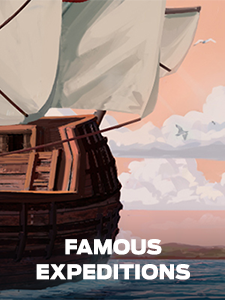
Part of the Famous Expeditions Collection
Set sail on the high seas with detailed 3D models of historic vessels. Learn about maritime explorers and add a noble replica to your library.
Originality of the Model
The author declares that this work is their personally shared model

This model is licensed under the following terms:
Credit must be given to the creator
Remixes must be shared under the same license
Models(5)
 FE_Drakkar_Oars_L1.stl
8.73 MB

2025-03-27
- FE_Drakkar_Oars_L2.stl
8.08 MB
2025-03-27
- FE_Drakkar_Oars_R2.stl
7.85 MB
2025-03-27
- FE_Drakkar_Base.stl
27.89 MB
2025-03-27
- TheDrakkar_AssemblyInstructions.pdf
16.72 MB
2025-03-27
View all(5)


