


'%3e%3cpath%20id='Rectangle%20995'%20d='M0%200H24C26.2091%200%2028%201.79086%2028%204V52C28%2054.2091%2026.2091%2056%2024%2056H0V0Z'%20fill='black'%20fill-opacity='0.2'/%3e%3cpath%20id='Vector'%20d='M17%2022L11%2028L17%2034'%20stroke='white'%20stroke-opacity='0.85'%20stroke-width='1.5'%20stroke-linecap='round'%20stroke-linejoin='round'/%3e%3c/g%3e%3cdefs%3e%3cclipPath%20id='clip0_1639_4805'%3e%3crect%20width='28'%20height='56'%20fill='white'/%3e%3c/clipPath%3e%3c/defs%3e%3c/svg%3e)
'%3e%3cpath%20id='Rectangle%20995'%20d='M0%204C0%201.79086%201.79086%200%204%200H28V56H4C1.79086%2056%200%2054.2091%200%2052V4Z'%20fill='black'%20fill-opacity='0.2'/%3e%3cpath%20id='Vector'%20d='M11%2022L17%2028L11%2034'%20stroke='white'%20stroke-opacity='0.85'%20stroke-width='1.5'%20stroke-linecap='round'%20stroke-linejoin='round'/%3e%3c/g%3e%3cdefs%3e%3cclipPath%20id='clip0_1639_4802'%3e%3crect%20width='28'%20height='56'%20fill='white'/%3e%3c/clipPath%3e%3c/defs%3e%3c/svg%3e)

- 0.2 mm layer height, 2‑wall walls, 15% infill density
'%20fill='%23B3B3B3'/%3e%3crect%20id='Rectangle%201051'%20x='8'%20y='2'%20width='12'%20height='0.5'%20transform='rotate(90%208%202)'%20fill='%23D9D9D9'/%3e%3crect%20id='Rectangle%201052'%20x='11'%20y='2'%20width='12'%20height='0.5'%20transform='rotate(90%2011%202)'%20fill='%23B3B3B3'/%3e%3cpath%20id='Rectangle%201048'%20d='M2%202H14V14H11L10.5%2014.5H8H5.5L5%2014H2V2Z'%20stroke='%23828282'%20stroke-linejoin='round'/%3e%3c/g%3e%3c/g%3e%3c/svg%3e)
1-disc
PLA
Designer

1

0
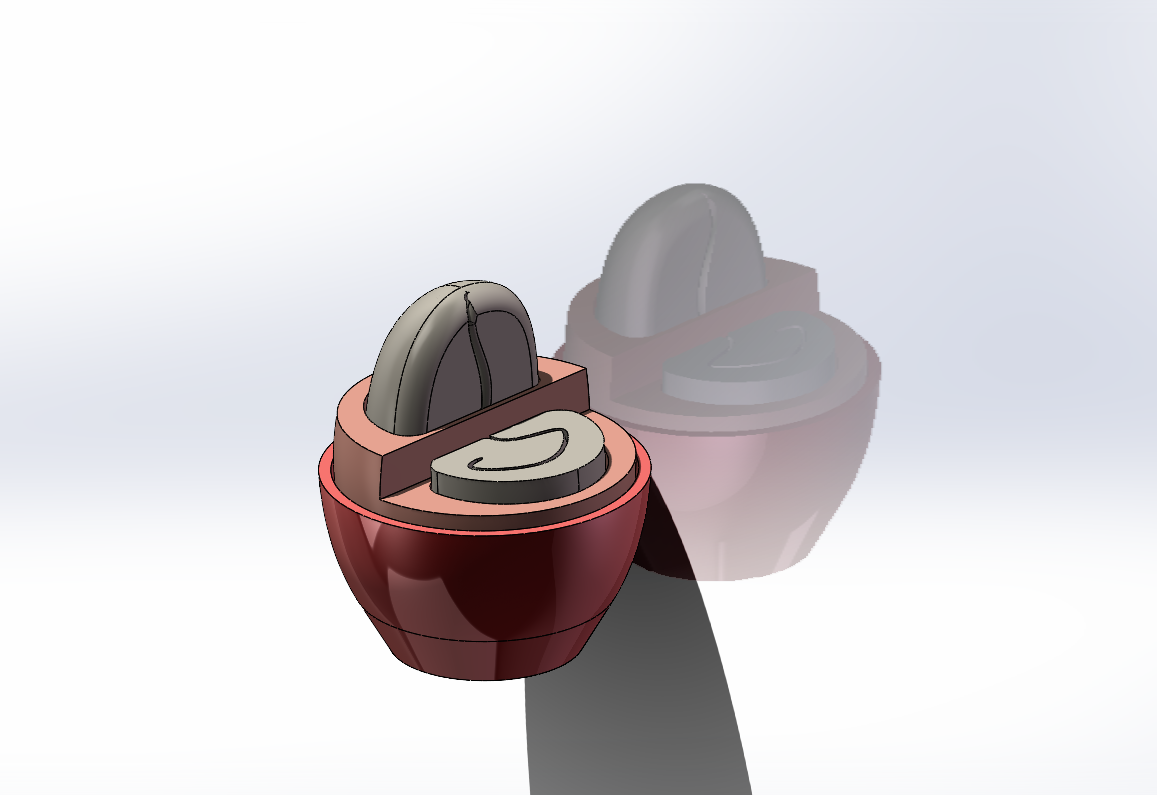
⭐Precise modeling with SolidWorks, featuring a well-structured design
🚀Model Overview
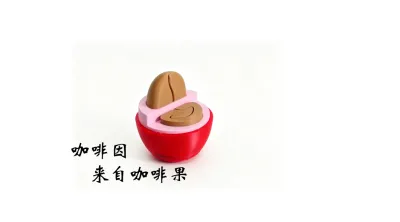
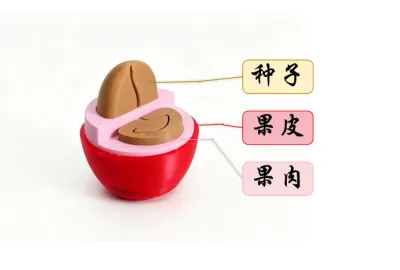
Coffee cherries are the drupes of plants belonging to the genus Coffea within the Rubiaceae family. Due to their round, juicy appearance, they are commonly referred to in the industry as “coffee berries.” A typical mature Arabica coffee cherry consists of five distinct layers—from the outside inward—namely, the exocarp, mesocarp (pulp), endocarp (parchment), seed coat (silver skin), and the seed itself. To meet the educational needs of elementary science instruction and introductory科普 activities, this model simplifies the structure into three core components most easily understood by beginners: the exocarp, pulp, and seed. Within the seed module, the endocarp and seed coat have been integrated to avoid overly intricate details that might confuse learners.
1. Exocarp
The exocarp is the dense protective outer layer of the coffee cherry, composed of a single layer of keratinized epidermal cells. When unripe, it appears dark green; as the fruit ripens, it gradually transitions to a vibrant bright red (with some varieties displaying yellow, orange, or purple hues). Its surface is smooth and exhibits a natural waxy sheen. Its primary functions include shielding the internal tissues from physical damage, pest and disease attacks, and moisture loss, thereby providing a stable developmental environment for the inner structures.
2. Mesocarp (Pulp)
Located beneath the exocarp, the mesocarp is a fleshy, thin-walled tissue and the only edible part of the coffee cherry. In regions like Yunnan, farms often offer hands-on experiences where visitors can pick fresh coffee cherries. When ripe, the mesocarp takes on a translucent, gel-like consistency, soft and juicy, rich in fructose, glucose, citric acid, and pectin. It supplies carbohydrates and other nutrients necessary for seed development, while its aroma attracts birds and other animals after ripening, facilitating natural seed dispersal. During industrial coffee processing,the pulp is completely removed through methods such as wet milling, sun-drying, or honey processing, leaving only the seeds for subsequent roasting.
3. Seed
Coffee beans are the reproductive organs of the coffee plant and serve as the raw material for everyday coffee beverages. A standard Arabica coffee cherry typically contains two flat, oval-shaped seeds arranged oppositely. Each seed features a distinctive deep central groove running down its length. The exterior of each seed is encased first by a thin yet tough endocarp (commonly called “parchment”) and then by a membranous seed coat (known as “silver skin”). Seeds store essential nutrients such as proteins and fats, which enable them to germinate under favorable conditions into new coffee plants.Unroasted green coffee beans may still possess germination potential—interested individuals are encouraged to try.
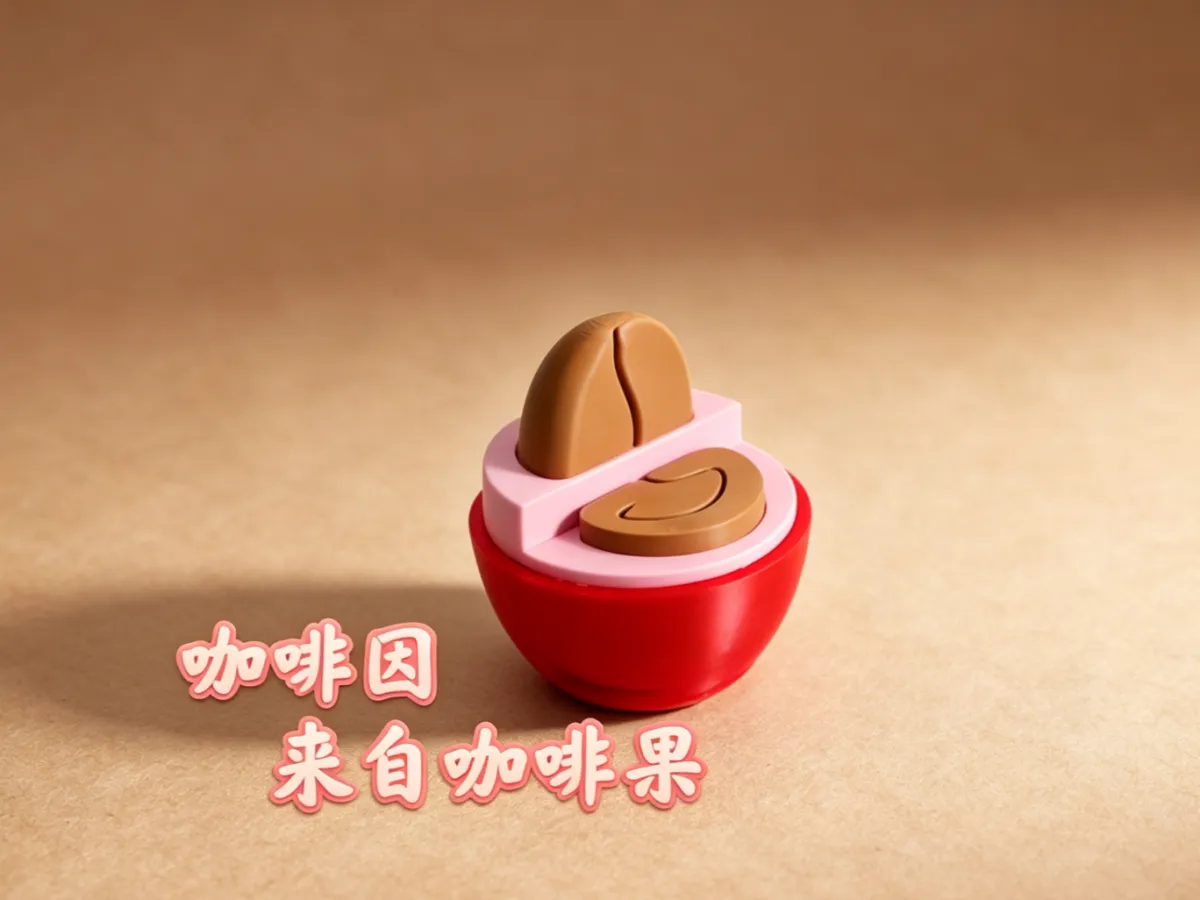
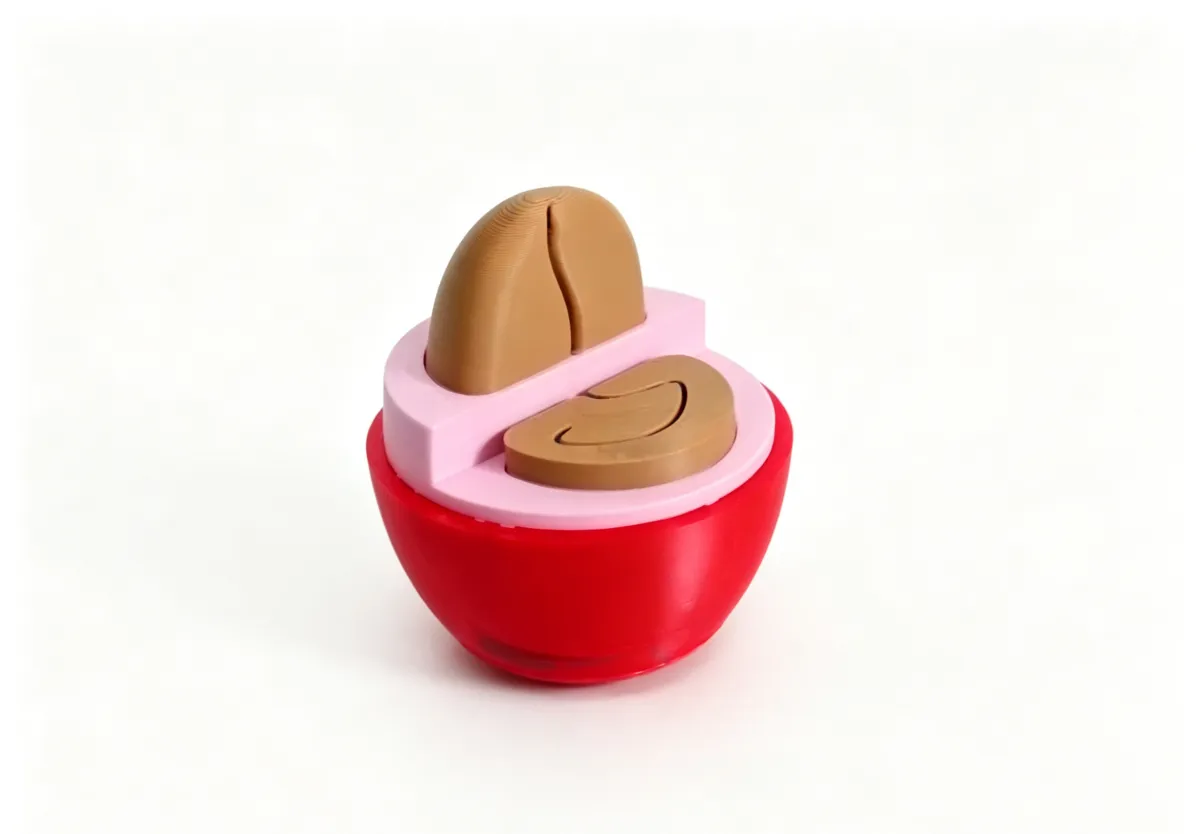
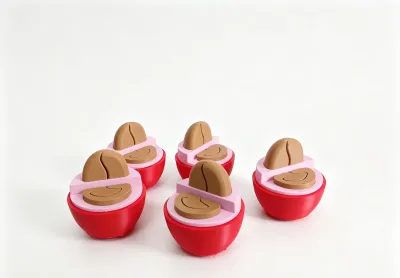
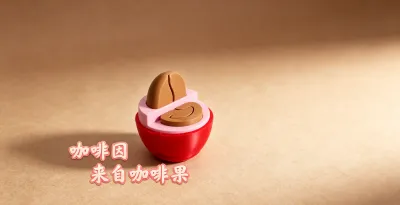
This model is based on the actual morphology of a mature Arabica coffee cherry, faithfully reproduced at a 1:1 scale. Utilizing FDM three-color simultaneous printing technology, it accurately captures the spatial relationships and morphological characteristics of the three core structural components.
The model employs a scientifically designed color-coding system: a bright red shell precisely replicates the rounded spherical contour of the exocarp along with its signature mature coloration; a pale pink structure reflects the thickness and spatial positioning of the mesocarp (pulp), clearly delineating its boundary against the red exocarp; and a brown structure meticulously reproduces the form and texture of the coffee bean seeds. Additionally, the model offers highly accurate replication of the coffee bean’s dual-seed arrangement, vividly illustrating the characteristic biological traits of Arabica cherries. It precisely recreates the unique depth and orientation of the central grooves, restoring their iconic shape, and innovatively incorporates a dual-perspective display design: the upper half presents the complete three-dimensional profile of the coffee bean, while the lower half reveals its cross-sectional anatomy. Students can thus grasp both the external appearance and internal structure of the seed using just one model.
The model has been thoughtfully engineered to meet educational requirements, with deliberate simplifications tailored to beginner-level understanding. Unnecessary fine structures like the endocarp and seed coat have been omitted, ensuring crisp, clear boundaries and striking color contrasts that allow users to quickly identify each component without additional instructions. Furthermore, the entire model is integrally molded in one piece, eliminating any detachable small parts, and all edges feature rounded corners, fully complying with school safety standards.
🚀Application Scenarios
With its simple, intuitive design, robust durability, and extremely low printing costs, this model finds broad applicability across three major domains: botanical education, coffee industry training, and public科普 initiatives. Specific scenarios include:
1. Botanical Education Settings
- Elementary and Secondary Science/Biology Classes: Ideal for teaching units such as “Plant Fruits” or “The Life Cycle of Angiosperms,” this model provides a tangible demonstration of the three-layered basic structure of drupes, addressing the limitations of static, abstract textbook illustrations. It can also be used alongside models of peaches, plums, and other drupes for comparative learning.
- University and Vocational College Courses: Suitable for courses in agronomy, horticulture, food science, and related fields, including plant anatomy, cultivation of cash crops, and agricultural product processing. It helps students understand the correspondence between the biological structure of coffee cherries and their processing techniques.
- Nature Education Camp Activities: As an accompanying educational tool for outdoor plant exploration, this model allows students to observe real coffee trees while gaining deeper insights into the internal architecture of their fruits.
2. Coffee Industry–Specific Applications
- Gourmet Coffee Shops: Placed at bar counters or product display areas, this model serves as both decorative and educational props. When customers order, staff can explain directly that “coffee beans aren’t beans—they’re seeds from the coffee tree,” enhancing brand professionalism and customer experience.
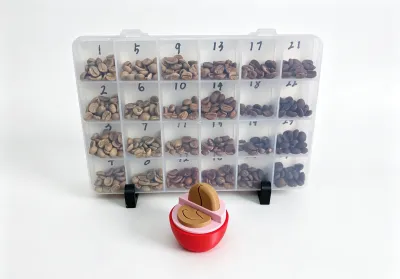
- Coffee Barista Training Classrooms: Used as a standard teaching aid for introductory coffee courses, paired with samples of green beans, roasted beans, and brewed coffee to systematically illustrate the complete supply chain “from coffee cherry to cup of coffee.”
- Coffee-Themed Public Outreach Events: Perfect for coffee festivals, farm open days, brand tasting sessions, and similar occasions, serving as an interactive exhibit that lets participants touch and examine the model firsthand, quickly building foundational knowledge about coffee raw materials.
3. Public Outreach and Personal Use
- Science Museums/Natural History Exhibits: As a compact interactive exhibit within sections dedicated to “Cash Crops” or “Plant Diversity,” ideal for young audiences to explore independently.
- Family Science Enrichment: A fun parent–child activity toy that nurtures children’s observational skills and scientific thinking while expanding their understanding of coffee culture.
- Coffee Enthusiast Self-Study: A desktop reference tool helping aficionados gain deeper insight into the principles and flavor differences among various coffee processing methods (wet milling, sun-drying, honey processing).
🚀Printing Recommendations
All printing parameters have been pre-configured for high success rates. If issues arise during printing, please refer to the troubleshooting tips below.
🚀Assembly Instructions
No assembly is required for multi-color printing configurations.
Originality of the Model
The author declares that this work is their personally original model
This model is licensed under the following terms:
This work is licensed under a Standard Digital File License. Digital files have a strict non-commercial, personal use only license.
You shall not share, sub-license, sell, rent, host, transfer, or distribute in any way the digital file or 3D printed versions of this object, nor any other derivative work of this object in its digital or physical format (including remixes of this object). You can not host these files on other digital platforms, web stores or cloud repositories. The objects may not be used in any way whatsoever in which you charge money, collect fees.
Models(1)
- 咖啡果 发布.3mfDesigner
'%3e%3cpath%20id='Vector'%20d='M13.6663%201.33331H2.33301C1.78072%201.33331%201.33301%201.78103%201.33301%202.33331V13.6666C1.33301%2014.2189%201.78072%2014.6666%202.33301%2014.6666H13.6663C14.2186%2014.6666%2014.6663%2014.2189%2014.6663%2013.6666V2.33331C14.6663%201.78103%2014.2186%201.33331%2013.6663%201.33331Z'%20stroke='%23808080'%20stroke-linejoin='round'/%3e%3cpath%20id='Vector_2'%20d='M11.3333%201.33331V7.33331H5V1.33331H11.3333Z'%20stroke='%23808080'%20stroke-linejoin='round'/%3e%3cpath%20id='Vector_3'%20d='M9.66699%203.66669V5.00002'%20stroke='%23808080'%20stroke-linejoin='round'/%3e%3c/g%3e%3cdefs%3e%3cclipPath%20id='clip0_3212_168684'%3e%3crect%20width='16'%20height='16'%20fill='white'/%3e%3c/clipPath%3e%3c/defs%3e%3c/svg%3e)
10.83 MB
'%3e%3cpath%20id='Vector'%20d='M7.99967%2014.6666C11.6816%2014.6666%2014.6663%2011.6819%2014.6663%207.99998C14.6663%204.31808%2011.6816%201.33331%207.99967%201.33331C4.31777%201.33331%201.33301%204.31808%201.33301%207.99998C1.33301%2011.6819%204.31777%2014.6666%207.99967%2014.6666Z'%20stroke='black'%20stroke-opacity='0.49'%20stroke-linejoin='round'/%3e%3cpath%20id='Vector_2'%20d='M8.00235%204.00006L8.00195%208.00299L10.8284%2010.8295'%20stroke='black'%20stroke-opacity='0.49'%20stroke-linecap='round'%20stroke-linejoin='round'/%3e%3c/g%3e%3cdefs%3e%3cclipPath%20id='clip0_1890_13189'%3e%3crect%20width='16'%20height='16'%20fill='white'/%3e%3c/clipPath%3e%3c/defs%3e%3c/svg%3e)
2026-05-23


