




Architecture
Miniature models
Ancient Architecture
Cultural and Creative Products
Sand Table
Miniature Scenes

- 0.2 mm layer height, 2-wall structure, 8% infill density

6-disc
PLA
Designer

4

1
“With whom shall I sit? The bright moon and the gentle breeze are mine.”
Important notes:
Please carefully select your settings. Configurations with difficult-to-remove supports tend to yield better results; for configurations that are easy to dismantle, consider reducing print speed or increasing fan speed.
Use as much glue as possible—502 adhesive works fine (just be sure to wear gloves). When installing the decorative brackets (those lattice‑like pieces), apply 502 in a thin stream at the very bottom, then use tweezers to make fine adjustments.
Material selection:
Roofing: Senhai’s smoky gray PLA Senhai 3D Printing Filament HS... - Taobao (this filament is especially well-suited for traditional Chinese tiled roofs).
Wood‑like material: R3D’s brown PETG.
Base and bricks: Jayo’s silver (gray from R3D would also work).
I may release a video tutorial in the next couple of days.
--------------------The following is the author’s rambling musings (which might be long and tedious)--------------
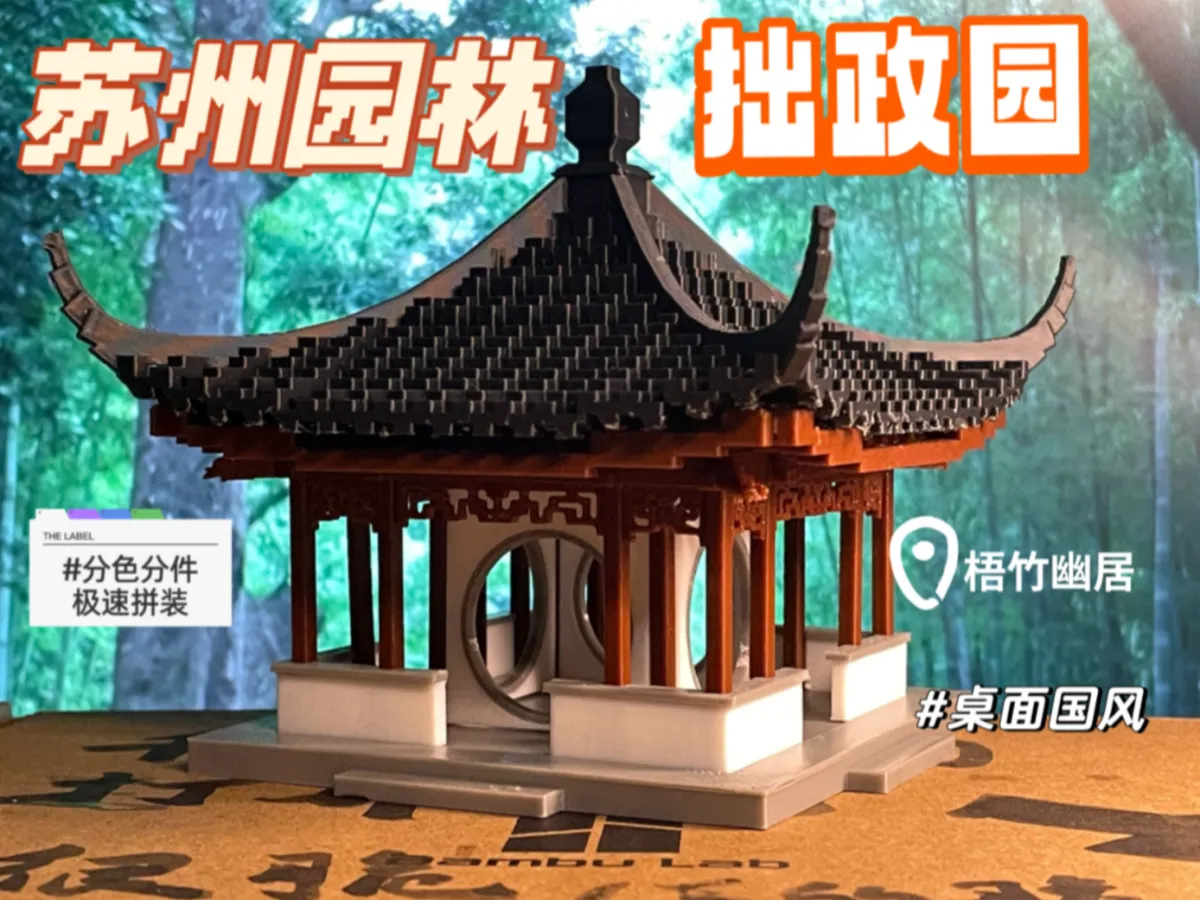
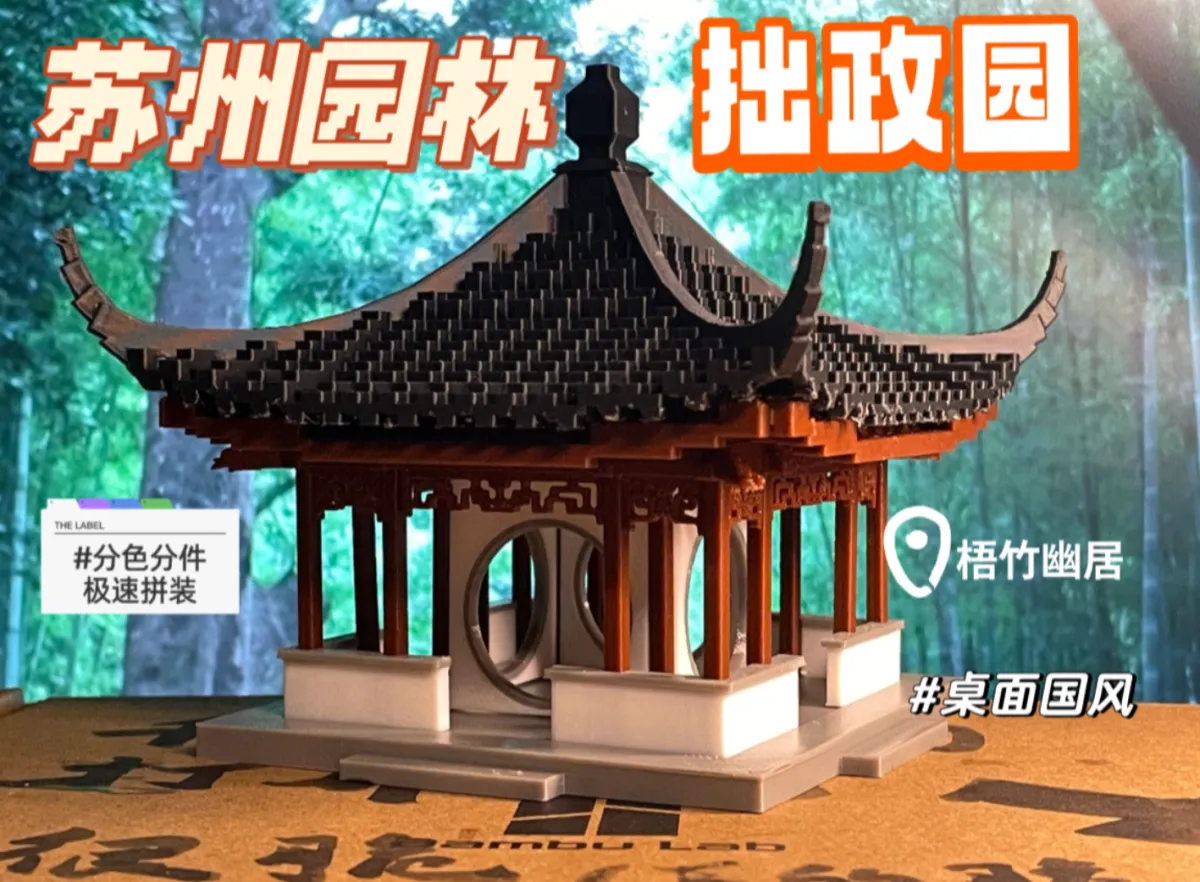
To be honest, I’ve always wanted to create something inspired by the Humble Administrator’s Garden. However, the iconic “Jianshan Tower” is quite large—while it could certainly be printed, the resulting data files might not look ideal. As a third-year student, I need to focus on simpler prints to earn some credits and keep my printer running (sigh… life demands it—please help me out!). Each time I finish a piece like the Canglang Pavilion, your support feels like a whip urging me to speed up. Originally, I planned to produce more official-style buildings from central or northern China—those intricate dougong brackets are visually striking. But as someone from the Jiangnan region, how could I resist crafting something closer to home? So I tried making the Canglang Pavilion—it turned out really well, so I posted it right away. Then I moved on to the Lüyi Pavilion, which was even better, especially when paired with the seat brackets. In fact, Jiangnan architecture lends itself beautifully to 3D printing: fewer dougong components mean a slightly simpler structure (not counting small wooden details—if we tried to replicate every tiny element, they’d probably end up shark‑finning me instead!), plus the color palette is harmonious: white walls, black tiles, and occasional wood accents. This time, my attempt at the Wuzhu Youju was mainly an experiment with wall textures and a moon gate, aiming to see how adding these elements would enhance the overall effect—and once it came out, wow, I was pretty pleased! Still, there’s one minor regret: I had hoped to build a small scene (like a fish tank), but alas, no materials! No funds to buy filaments—oh dear! ← That’s my subtle hint for your support. With autumn deepening rapidly in November and December, the garden’s fall scenery is absolutely breathtaking. I wanted to print maple leaves, place them atop the structure, and frame everything with a window view—but the tree models available on Taobao were far too crude, requiring extensive post‑processing. After considering gradient‑colored filaments, I decided to just give up and move on. Please, everyone, lend me a helping hand—TAT!
I hope you enjoy what I’ve created! If there’s anything specific you’d like to see, leave a comment below—I’ll happily arrange it. Each individual piece comes together fairly quickly, usually within two to three days. A little bit of support gives me an extra boost—thanks for your encouragement!
Originality of the Model
The author declares that this work is their personally original model
This model is licensed under the following terms:
Credit must be given to the creator
Only noncommercial uses of the work are permitted
Models(1)
- 梧竹幽居.3mfDesigner

31.39 MB

2026-05-28


