



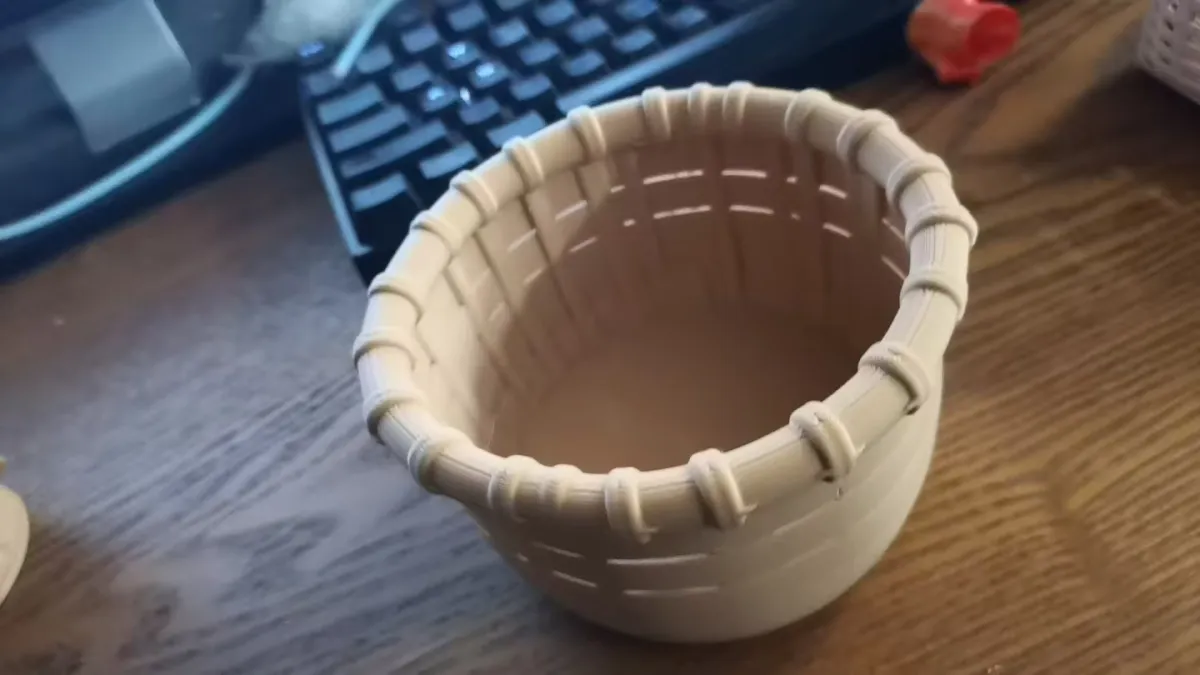



Matte PLA Bamboo Basket
Bamboo-Infused Elegant Basket
Matte Woven Basket
Chinese-style bamboo basket
3D‑Printed Matte Basket
Hollow Bamboo Woven Basket
Rounded Handle Bamboo Basket
Matte Storage Basket
Chic Chinese Style
Oriental Bamboo Rhythm
Small Lifestyle Aesthetic Accessories
Reproduction of Intangible Cultural Heritage Bamboo Weaving
Soft, Matte Finish
Minimalist Storage

- 0.2 mm layer height, 3‑layer walls, 15% infill density

1-disc
PLA
Designer

1

0
1. Source of Inspiration (Exclusive Matte PLA Bamboo Basket Edition)
This bamboo basket design draws inspiration from the timeless aesthetic of traditional Chinese bamboo weaving—a heritage craft celebrated for its understated elegance and warm, muted tones. Specifically crafted to complement matte PLA filaments, the model captures the essence of classic flat-weave patterns while streamlining intricate production processes. It retains the airy, openwork quality of bamboo weaving, paired with rounded, ergonomic handles that echo the soft, harmonious forms of Eastern design. By eschewing glossy finishes in favor of matte PLA, the design subtly evokes the natural, rustic charm of bamboo strips—while the deliberate use of slow printing on overhanging surfaces ensures both structural integrity and a refined, low‑key aesthetic. Whether used as a discreet desktop organizer or as a subtle accent in contemporary Chinese interior decor, this piece effortlessly conveys a sense of understated sophistication, bringing the beauty of traditional bamboo weaving into everyday life through the lightweight, versatile medium of 3D printing.
2. Printing Configuration Guide (Detailed Version: Dedicated Matte PLA Filament—Focus on Slow Printing, Single Support for Handles, and Overhanging Surfaces Without Additional Bracing)
✅ Core Requirements: Use exclusively matte PLA filament | No supports required for overhanging surfaces or woven gaps in the basket body | Add supports only at the handle area | Maintain slow printing throughout the entire build to ensure proper part formation | Strongly recommend using skirted edges to prevent warping along the basket’s rim
⚠️ Key Considerations: Matte PLA filaments are highly prone to deformation; slow printing is critical for successfully achieving stable overhangs without support, while localized supports at the handle help prevent breakage. Full‑scale cooling throughout the print process ensures that the matte finish remains pristine, free from any unwanted gloss or surface imperfections.
Basic Core Print Settings (Specifically Optimized for Matte PLA and Tailored to the Bamboo Basket Structure—Follow These Parameters Precisely)
1. Printing Technology: FDM (Fused Deposition Modeling) is the ideal choice for matte PLA, delivering consistent results and faithfully reproducing the delicate, openwork texture of bamboo weaving without strain.
2. Dedicated Filament: Matte PLA, 1.75 mm (available in natural wood, bamboo green, or off‑white)—these colors perfectly capture the earthy, matte质感 of bamboo, offering a non‑reflective finish that exudes a refined, high‑end aesthetic, perfectly suited to tabletop displays and decorative accents.
3. Layer Height: Prioritize 0.15 mm (our top recommendation! This layer height delivers a smooth matte finish, crisp woven details, and precise openwork spacing—no visible layer lines; alternatively, 0.2 mm offers a good balance between efficiency and surface quality, while still maintaining a clean, matte finish).
4. Infill Density: Set the main body of the basket to 12–15% infill (low infill for a lightweight, airy feel that avoids bulkiness while fully showcasing the openwork effect); increase infill to 20–22% around the handle and at the junction between the handle and basket body (critical for reinforcement! Matte PLA is less resilient than PETG, so higher infill helps enhance load-bearing capacity, ensuring the handle can withstand daily use without breaking—and meets the handle’s specific stress requirements).
5. Temperature Settings: The “life and death” threshold for matte PLA—get the temperatures wrong, and your print is likely to fail, with the matte finish easily losing its intended subtlety and becoming dull or mottled. Optimal nozzle temperature: 200–215°C (with 205°C being the sweet spot—this ensures even melting of the matte filament, preventing stringing or nozzle clogs, and preserving the matte finish without any grayish haze after printing). Bed temperature: 60°C (a fixed value! Matte PLA adheres just right to the build plate—no warping, no sticking, and easy removal with no residual adhesive, all while protecting the matte surface from damage).
6. Slow Printing Throughout the Build (A Must—especially for overhanging surfaces and unsupported gaps where matte PLA requires careful, controlled printing): Print outer walls, basket details, overhanging surfaces, and woven openwork areas at 25–30 mm/s (maintain a consistently low speed to prevent overhang collapse, minimize stringing, keep openwork gaps clean and free of excess material, and ensure a smooth, flawless matte finish); increase print speed to 40–45 mm/s in filled areas (only here do we allow a slight boost in speed to balance efficiency without compromising the matte finish); set handle print speed to 28–30 mm/s (the handle is a load‑bearing component—slow printing ensures dense, uniform layer deposition and a smooth, continuous matte surface without any visible discontinuities).
7. Cooling Settings: Exclusive to matte PLA—maximize cooling to guarantee proper part setting and preserve the matte finish: Run the fan at 100% power throughout the entire print (start immediately after the first layer is completed—matte PLA cools quickly and sets firmly, preventing overhanging surfaces from softening or deforming while keeping the matte finish smooth and free of bulges or oily sheen). Enable continuous cooling between layers without interruption—this ensures faster, more stable part setting.
8. Retraction Settings: Critical for maintaining a clean matte finish and pristine openwork gaps—prevent stringing that could ruin the matte surface. Set retraction distance to 5–6 mm, retraction speed to 40–45 mm/s, and retraction delay to 0.4 seconds, then activate the anti‑stringing feature. When printing openwork gaps, automatic retraction helps avoid stringing that might clog the gaps—or inadvertently smudge the matte surface of the basket body, ensuring the final print achieves its full, polished aesthetic.
9. Line Width & Wall Thickness: Designed to optimize both strength and transparency for matte PLA. Line width: 0.4 mm (matches standard nozzle diameters, accurately reproducing the fine lines and textures of woven patterns without closing gaps or causing adhesion issues). Basket wall thickness: 1.2 mm for a lightweight yet sturdy structure with excellent matte transparency; handle wall thickness: 1.5 mm—thicker walls provide enhanced load‑bearing capacity, reducing the risk of bending or breaking in matte PLA.
10. Additional Basic Settings: To maximize the yield of high‑quality matte prints, enable dimensional compensation by +0.05 mm—matte PLA exhibits slight shrinkage, so adjusting for this ensures openwork gaps remain at their intended size. Disable minimum layer time for the fan—this ensures each layer cools evenly, preventing localized whitening on the matte surface. Align the print direction along the woven grain to maintain a seamless, uninterrupted matte finish across the entire part.
Originality of the Model
The author declares that this work is their personally original model
This model is licensed under the following terms:
Credit must be given to the creator
Models(1)
- 素编圆箩.3mfDesigner

9.18 MB

2026-01-30


