












Make It Real
christmas tree fidget toy
carrot tower
expanding christmas tree
fidget toy
stress relief
christmas decoration
3d printed gift
holiday toy
christmas tree carrot tower
expandable toy
nested structure
toy

- 0.2mm layer, 2 walls, 15% infill

1-disc
PLA
Designer

236

7
Source of Inspiration
The starting point for this piece was my desire to transform a Christmas Tree, a symbol familiar to everyone, into a 3D-printed object that doesn’t merely “look like a Christmas tree,” but can actually be unfolded, folded, and repeatedly played with.
A Christmas tree itself possesses a very clear visual language: a pointed top, branches spreading out in layers, a trunk at the base, and an overall form that gradually expands from top to bottom.
In pondering this, I wondered: what if we combined such a classic holiday icon with the Carrot Tower multi-layered nested structure that I admire so much? Might this create a fresh expression—rich in festive spirit yet intriguingly structured?
And so, this Christmas Tree Carrot Tower – Fidget Toy was born.
From Christmas Tree Silhouette to Carrot Tower Structure
This design isn’t simply about crafting an ordinary Christmas-tree ornament. Instead, it first preserves the tree’s most recognizable overall shape, then iteratively repeats and shrinks that silhouette inward, forming numerous continuously arranged nested layers.
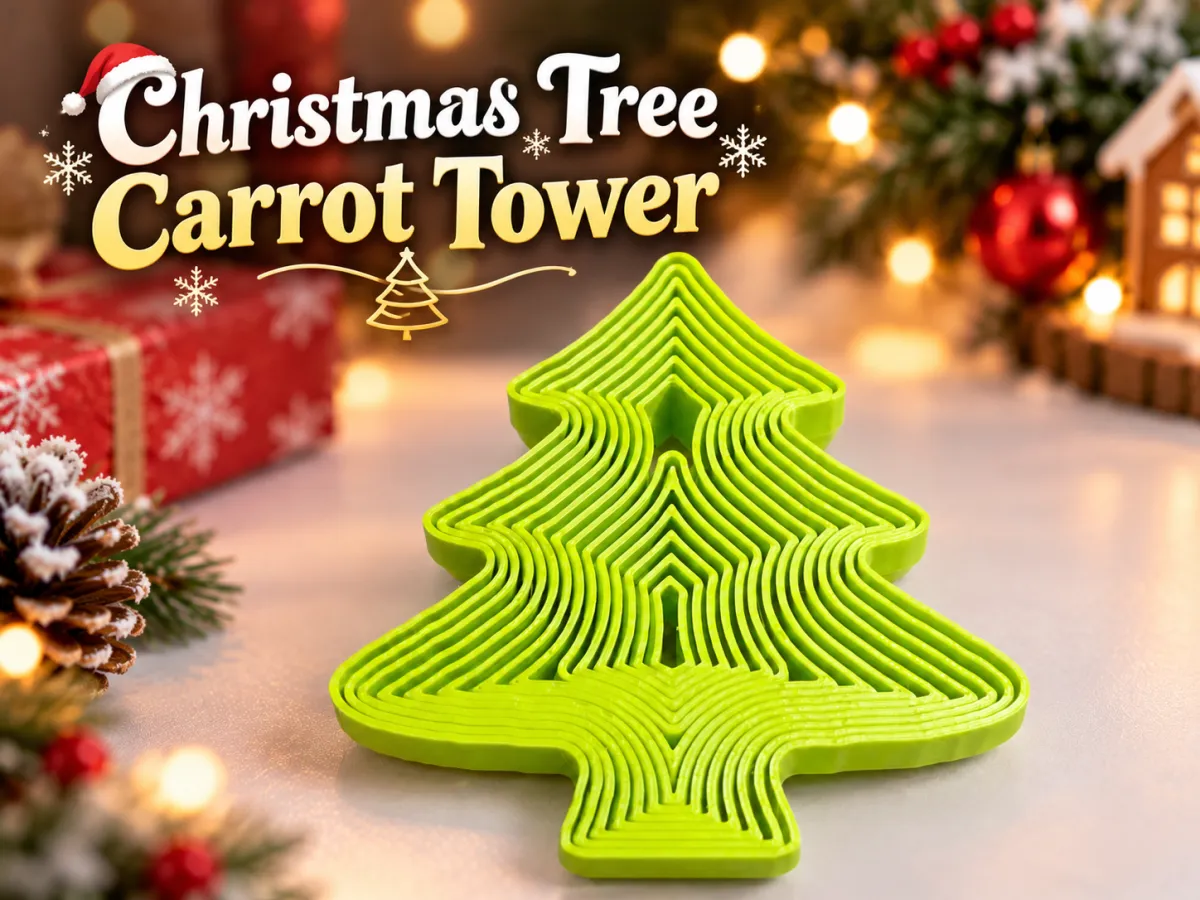
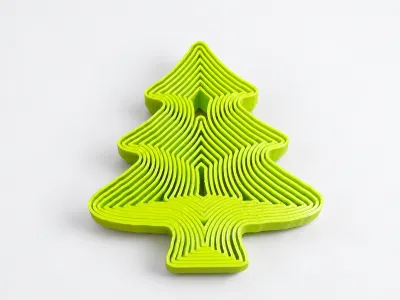
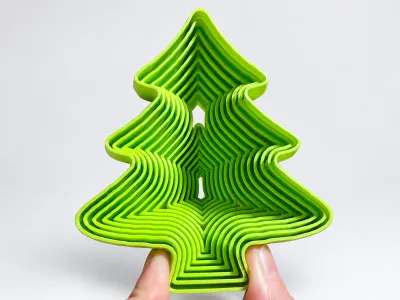
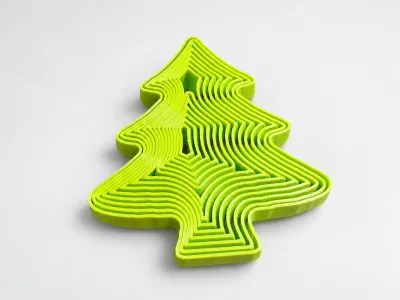
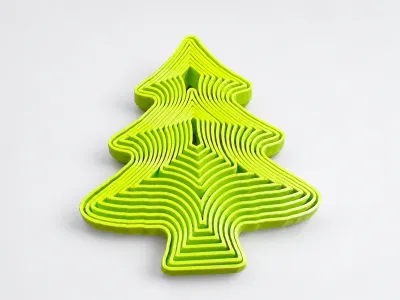
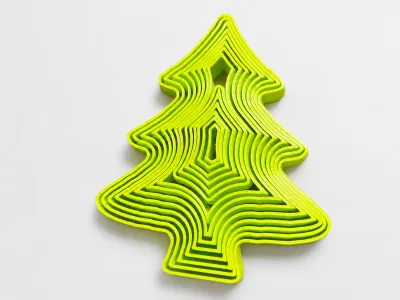
From a bird’s-eye view, the entire model appears as a series of concentric Christmas-tree silhouettes stacked atop one another.
It retains the tree’s distinct external form while also evoking a sense of order and rhythm reminiscent of contour lines, tree rings, or topographic maps.
I particularly appreciate this effect because it doesn’t just involve drawing a few more circles inside the Christmas tree—it transforms the entire form from the outset into a structurally logical Carrot Tower piece.
Engaging Branches, Canopy, and Trunk in Structural Transformation
What makes this work especially interesting is that the Christmas tree isn’t a simple triangle.
It features layered canopy, recessed spaces between branches, and a distinctly recognizable trunk serving as a stable support.
Therefore, during the design process, I didn’t merely have the outer outline shrink inward; instead, I integrated these internal transitions, grooves, and the trunk area into the nested transformation as well.
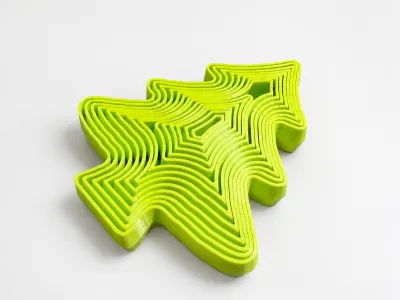
As a result, every layer of lines within the model bends and shifts in response to the tree’s own shape, making the structure far richer rather than monotonously repetitive.
The final outcome is a model that not only resembles a Christmas tree on the outside but whose internal structure has likewise “grown” into the form of a Christmas tree.
The Real Fun Lies in the Transition from Flat to Three-Dimensional
The heart of this piece lies not just in its appearance, but in how it interacts with the user.
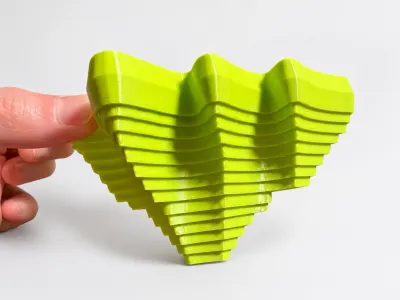
It employs the Carrot Tower telescoping nesting mechanism.
When collapsed, the entire model looks like a relatively compact, layered Christmas-tree pattern.
But as the structure is gradually lifted and unfolded, the originally tightly stacked outlines begin to gain height, transforming the piece from an almost flat surface into a tower with distinct layers and spatial depth.
This transformation is truly fascinating:
- When collapsed, it resembles a flattened, patterned Christmas tree.
- When unfolded, it seems to emerge from a two-dimensional design as a three-dimensional Christmas tree.
- And when collapsed again, it returns to its neat, compact state.
This cyclical shift between flat → three-dimensional → flat is precisely what gives this work its greatest charm.
Turning a Festive Symbol into an Interactive Structural Piece
One aspect I particularly love about this piece is that it preserves the visual memory of Christmas while going beyond a traditional holiday ornament.
In terms of form, it’s a Christmas tree, naturally imbued with a clear festive atmosphere;
in terms of structure, it’s a fidget toy that can be unfolded, folded, and repeatedly manipulated.
In other words, it’s not just a “Christmas decoration”—it’s a genuinely interactive 3D-printed creation.
This aligns perfectly with the design direction I wish to convey:
Instead of making the Christmas tree more complex, I aim to turn the Christmas tree itself into a structure that can be handled and experienced.
3D Printing Makes This Vision a Reality
Structures featuring numerous continuous nested contours and requiring transitions from flat to three-dimensional are ideally suited for realization through 3D printing.
Through modeling, I can precisely control the relationships between each layer of outlines, the transitions at branch junctions, the connections between trunk and main body, and the structural behavior during unfolding and collapsing.
These elements might remain little more than an intriguing pattern on paper; but with 3D printing, they become tangible objects—ready to be held, unfolded, folded, and repeatedly explored.
Ultimately, what I hope to achieve is not simply “making a Christmas tree,” but:
Enabling a Christmas tree to grow right out of the plane.
This encapsulates the core creative intent behind the Christmas Tree Carrot Tower – Fidget Toy.
Originality of the Model
The author declares that this work is their personally original model
This model is licensed under the following terms:
Credit must be given to the creator
Only noncommercial uses of the work are permitted
Models(1)
- Christmas Tree Carrot Tower.3mfDesigner

876.92 KB

2026-10-30


