


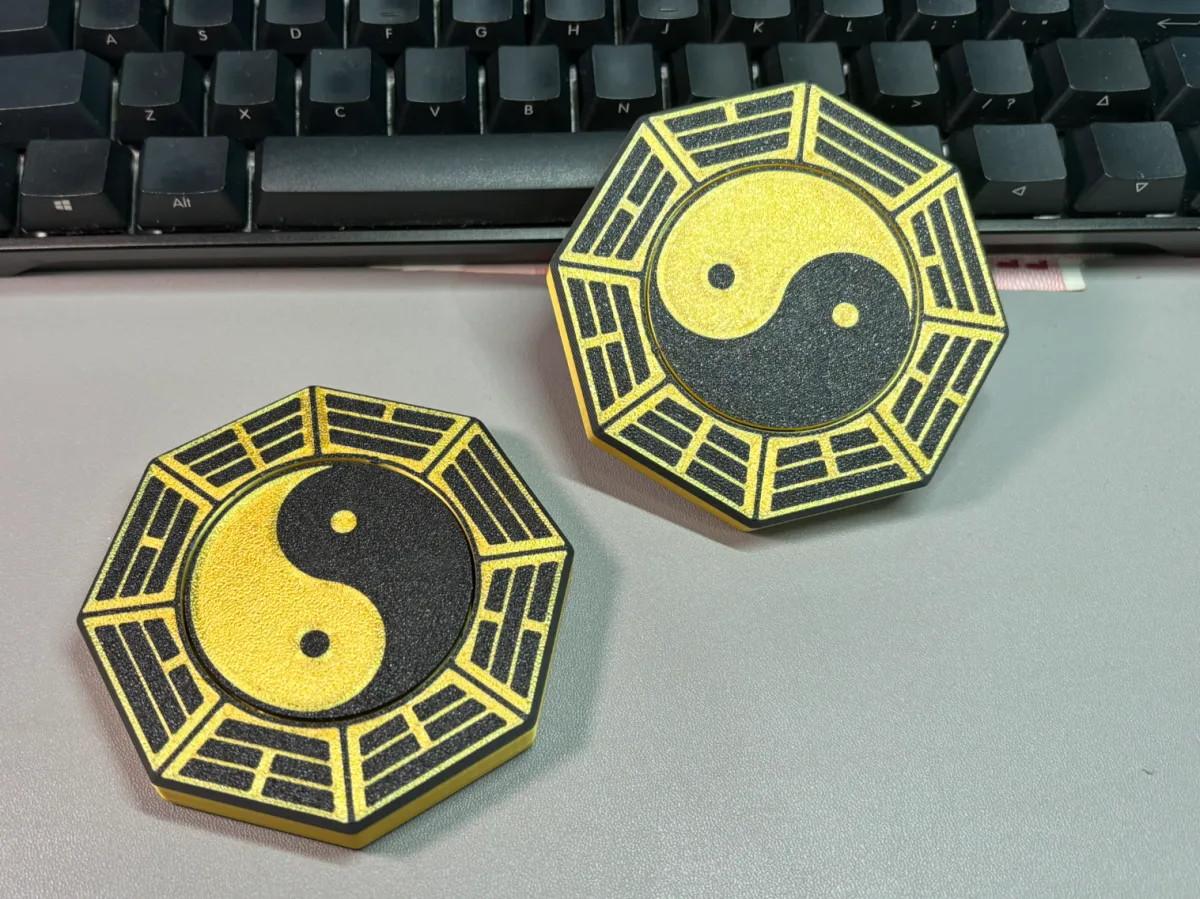
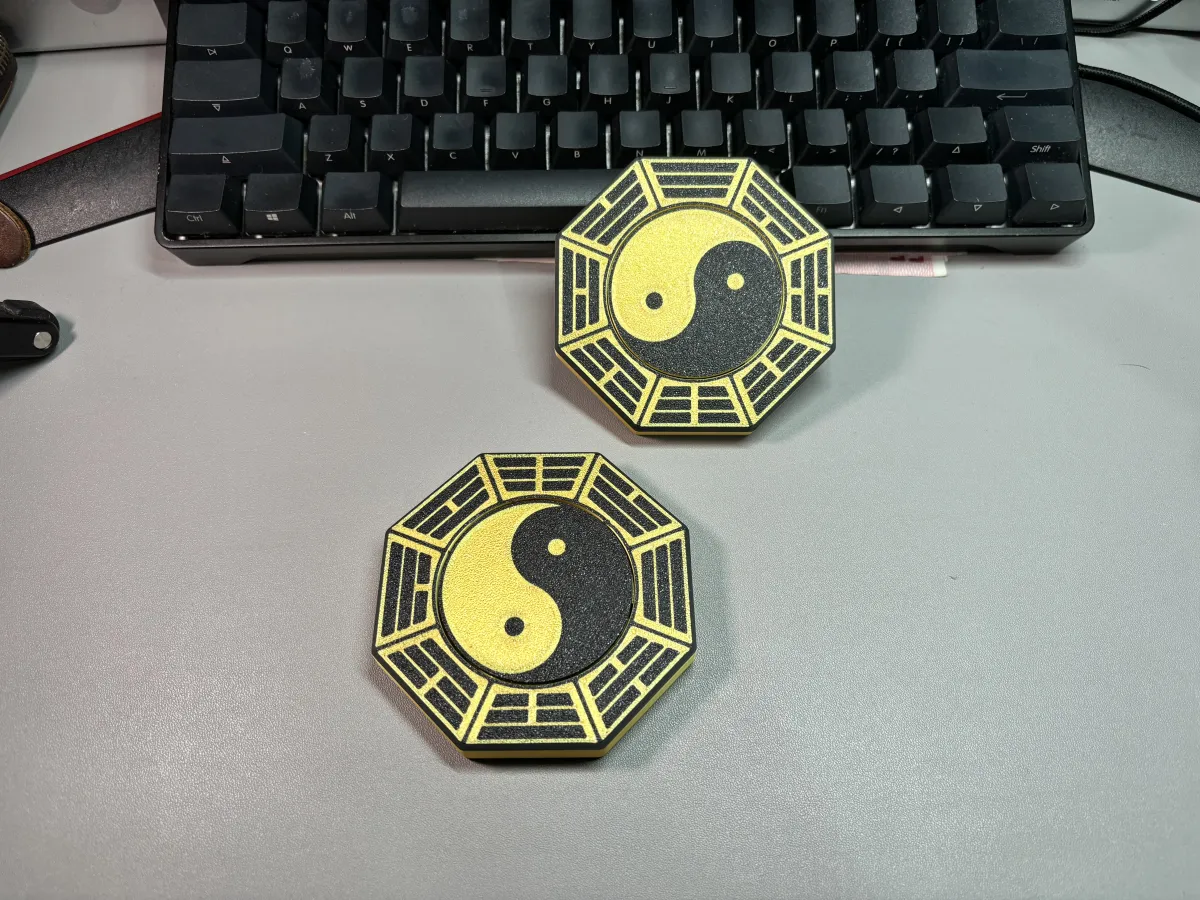

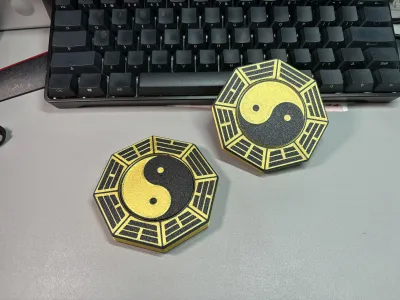
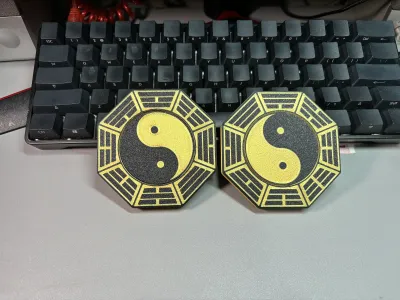

Props
Feng Shui
Eight Trigrams
Five Elements and Eight Trigrams
Bagua Pendant

- Layer height: 0.16 mm, 3‑layer walls, 15% infill.

2-disc
PLA
Designer

2

1

Bill of Materials
Bearing, 1 piece
Model: R188; Specifications: Outer diameter 12.7 × 6.35 × 4.76 mm
Spring, 1 piece
Specifications: Wire diameter 0.4 mm × Diameter 5 mm × Length 20 mm
For greater elasticity, you can choose a wire diameter of 0.5 mm while keeping other dimensions unchanged
When sharing this video, please credit the author: Qiu Se Yi Nong
TikTok/WeChat ID: qsyn2012
QQ Group: 731173959 – Se Mo Fang
Farm owners may visit
There are three main theories regarding the origin of the Eight Trigrams:
1. Fuxi drew the Eight Trigrams on Guaitai Mountain. Later, Tianshui in Gansu and Henan also claimed to be the site where Fuxi created the trigrams. Guaitai Mountain, also known as "Painting Trigram Platform," is traditionally believed to be the place where Fuxi observed celestial phenomena above and studied earthly geography below, thus creating the Eight Trigrams. Located at the northwestern end of Sanyang River, it now falls under the jurisdiction of Weinan Town, Maiji District. However, many modern scholars doubt this claim, arguing that later generations attributed certain inventions to ancient figures. Additionally, the Qingdun Site in Haian County, eastern Jiangsu—dating back to the late Neolithic period—yielded eight hexagram-based numerical trigrams in 1979. In such an era of sparse populations, numerous tribes, and limited communication tools, spreading these symbols across vast distances like eastern Jiangsu would have required a lengthy process. Historical records indicate that the Eight Trigrams originated from the He Tu and Luo Shu. According to legend, Fuxi invented them, initially sketching the trigrams on Guaitai Mountain in Tianshui, marking the beginning of creation.
2. Zhang Zhenglang’s theory posits that the Eight Trigrams evolved through multiple stages of divination numbers: His paper “A Preliminary Interpretation of Yijing Hexagrams Found on Early Zhou Dynasty Bronze Inscriptions” examines numerically inscribed trigrams unearthed in the twentieth century. He argues that there were initially numerous divination numbers (numerical trigrams), which later simplified into fewer types. During the Warring States period, these reduced values further condensed into binary odd–even symbols represented by the digits one and six—thus forming the symbolic Eight Trigrams. By the late Warring States and Qin–Han periods, these abstract binary yin–yang symbols emerged, eventually becoming the universally recognized yin–yang notation we see today. This view significantly contradicts some ancient texts and has considerable influence.
3. Liu Linying’s theory suggests that the Eight Trigrams arose from astronomical observations of six basic trigrams. In his work “A New Interpretation of the Origins of the I Ching,” he explains that the trigrams originated from predictive activities using gnomon instruments. Initially, the system consisted of six trigrams without Kan or Li, later evolving into the Eight Trigrams. Key evidence supporting this theory includes the fact that the six-trigram system—such as the Three Yin and Three Yang—is a core theoretical framework in traditional Chinese medicine, something the Eight Trigrams alone cannot fully explain. Moreover, remnants of lunar trigrams within the "Gui Cang" and "I Ching" texts provide additional support. His subsequent paper, “An Examination of the Use of Six-Image Divination Methods in Shang and Zhou Numerical Trigrams,” refutes the idea that the Eight Trigrams stemmed from divination numbers, instead asserting that during the millennia preceding the Eastern Zhou dynasty, when the four-image Dàyǎn divination method dominated, the I Ching relied primarily on six-image methods. Complex numerical calculations were merely supplementary aspects of the six-image system, with the essence of yin–yang being rooted in the six-trigram structure itself. Thus, the evolution of the Eight Trigrams was part of a long history of divination, and the abstract concept of yin–yang has very ancient origins.
These three theories carry relatively strong evidentiary weight. Other perspectives exist as well—for example, Liu Jue proposed in 1946 the "Gnomon Shadow Theory," suggesting that the Eight Trigrams originated from recording solar shadows with a soil gnomon; Feng Youlan argued that the Eight Trigrams derived from turtle-shell omens used for divination, standardized as "omen signs." Similar ideas include Qu Wanli's theory that the Eight Trigrams came from turtle-shell divinations. Meanwhile, Li Jingchi suggested that ancient people recorded divination results using knotted ropes, which later developed into the Eight Trigrams—a hypothesis based on the mythical name "Ba Suo" found in ancient texts.
These are the various theories concerning the origins of the Eight Trigrams. As for the origins of the individual lines, that constitutes another topic altogether: the lineages themselves.
P.S.: An ancient Taiji diagram depicted on painted pottery from the Dawenkou Culture site in Tai’an, Shandong Province
Trigram Symbols
Trigram symbols, also called category symbols, represent broader typologies rather than specific entities. The I Ching establishes its language based on these symbols, with symbolic numbers serving as the foundation of meaning. Works like the "I Ching," "Yi Lin," and the Plum Blossom Method all interpret outcomes according to symbolic meanings. Given the wide range of possible interpretations, specific analytical approaches must be tailored to each case.
Basic Trigram Symbols
The "Commentary on the Applicable Trigrams" in the "Book of Changes" introduces several fundamental trigram symbols.
Cosmological Perspective
Qian represents Heaven, Kun represents Earth, Zhen represents Thunder, Xun represents Wind, Kan represents Water, Li represents Fire, Gen represents Mountain, and Dui represents Marsh.
Family Perspective
Qian stands for father, Kun for mother, Zhen for eldest son, Xun for eldest daughter, Kan for middle son, Li for middle daughter, Gen for younger son, and Dui for younger daughter.
Animal Perspective
Qian symbolizes horse, Kun cow, Zhen dragon, Xun chicken, Kan pig, Li pheasant, Gen dog, and Dui sheep.
Body Perspective
Qian corresponds to head, Kun to abdomen, Zhen to feet, Xun to thighs, Kan to ears, Li to eyes, Gen to hands, and Dui to mouth.
Movement Perspective
Qian embodies vigor, Kun compliance, Zhen dynamism, Xun penetration, Kan entrapment, Li elegance, Gen stillness, and Dui discourse.
Power Perspective
Qian signifies ruler, Kun populace.
Expanded Trigram Symbols
Expanded symbols refer to broadly representative imagery. The "Commentary on the Applicable Trigrams" lists several examples, while Song Dynasty scholar Shao Yong’s "Plum Blossom Method" introduces more. Contemporary works like Zhang Yansheng’s "Extended Trigram Symbolism"—spanning three volumes totaling hundreds of thousands of characters—also present numerous expanded symbols. Due to their sheer volume, detailed discussion here is not feasible.
Major Types
Broadcasting
Editing
The Eight Trigrams come in different varieties. Since Song Dynasty scholar Shao Yong’s theory gained widespread popularity through Zhu Xi’s dissemination, the concepts of innate and acquired trigrams have become familiar to the general public. However, the "mid-heaven" trigrams recently proposed by contemporary thinkers remain largely unknown.
Innate Trigrams
Shao Yong refers to innate trigrams as "Fuxi’s trigrams," documenting their arrangement in "The Royal Canon of Universal Time." Shortly after his death, diagrams of innate trigrams began circulating. These are often paired with Taiji diagrams, where Taiji represents the unity of yin and yang, embodying primordial chaos. Consequently, some call "Taiji-style innate trigrams" "primordial trigrams."
The primary basis for innate trigrams lies in the "Commentary on the Applicable Trigrams": "Heaven and Earth establish their positions; mountains and marshes exchange energy; thunder and wind interact closely; water and fire do not clash. The trigrams interweave, with past trends following the flow and future trends reversing accordingly—hence the 'reverse counting' nature of the I Ching."
Following the principle of assigning yang to the left and yin to the right, with heaven above and earth below, the trigrams are arranged as follows: On the southern side, the four yang trigrams—Qian, Dui, Li, and Zhen—are positioned counterclockwise, starting from Qian and progressing toward Dui, then Li, and finally Zhen. Meanwhile, on the northern side, the four yin trigrams—Xun, Kan, Gen, and Kun—are arranged clockwise, beginning with Qian and moving toward Xun, then Kan, followed by Gen, and concluding with Kun. This arrangement gives rise to the innate trigram diagram.
Note that the yin–yang distinction here is determined by the lowest line of each trigram: Qian, Dui, Li, and Zhen all have positive lines (—), whereas Xun, Kan, Gen, and Kun feature negative lines (--). This tripartite feng shui approach—also known as the auxiliary star water method—first determines the yin–yang balance of the Eight Trigrams, then further refines the heavenly stems and earthly branches. From this emerges the second set of numbers associated with the Eight Trigrams—the innate trigram nine-square grid (see inner-layer numbers): Qian nine, Dui four, Li three, Zhen eight, Xun two, Kan seven, Gen six, Kun one. (Inner-layer numbers reflect the innate trigram configuration, while outer-layer numbers denote sequential numbering.) These numbers are utilized in Xuan Kong Taiyi feng shui.
Mid-Heaven Trigrams
Contemporary scholars began proposing various mid-heaven trigram maps in the 1990s, sparking debate. See relevant entries for details.
Liu Linying introduced the Ta Yi Jiazi number system and the trigram inclusion theory, asserting that the primary basis for mid-heaven trigrams also resides in the "Commentary on the Applicable Trigrams":
"The trigrams interweave; past trends follow the flow, future trends reverse accordingly—hence the 'reverse counting' nature of the I Ching.
Thunder energizes, wind disperses, rain moistens, sun illuminates,
Gen restrains, Dui delights, Qian governs, Kun stores. The Emperor emerges from Zhen…"
Acquired Trigrams
Drawn by King Wen of Zhou, the sage monarch of the Zhou Dynasty.
The primary basis for acquired trigrams lies in the "Commentary on the Applicable Trigrams":
"The Emperor emerges from Zhen, aligns with Xun, meets with Li, assigns duties to Kun, speaks through Dui, fights via Qian, labors through Kan, and concludes through Gen…"
Acquired trigrams address post‑event scenarios. With Qian as father, Kun as mother, Zhen as eldest son, Xun as eldest daughter, Kan as middle son, Li as middle daughter, Gen as younger son, and Dui as younger daughter.
Acquired trigrams pair with Luo Shu numbers: Qian six, Dui seven, Li nine, Zhen three, Xun four, Kan one, Gen eight, Kun two. A mnemonic verse sums it up: One number for Kan, two for Kun; three for Zhen, four for Xun—split evenly; five for the central palace, six for Qian; seven for Dui, eight for Gen, nine for Li.
Xuan Kong feng shui employs flying stars to assess auspiciousness or misfortune, using the Purple White Nine Stars to determine good or bad fortune. The Purple White Nine Stars originate from the acquired trigram–Luo Shu pairing. When transferred into the Luo Shu grid, this becomes known as the Luo Shu Nine Palace Diagram. The Xuan Kong Flying Star Chart is derived directly from this Luo Shu Nine Palace Diagram.
Ancient people marked directions exactly opposite to modern practices. Modern orientation places north at the top, south at the bottom, west on the left, and east on the right, whereas ancient orientations reversed these conventions: north at the bottom, south at the top, west on the right, and east on the left. The Luo Shu Nine Palace Diagram clearly demonstrates the one-to-one correspondence between numbers, trigrams, and directional placements:
One represents Kan, located due north;
Two represents Kun, situated southwest;
Three represents Zhen, positioned east;
Four represents Xun, located southeast;
Five represents the central palace;
Six represents Qian, placed northwest;
Seven represents Dui, located west;
Eight represents Gen, positioned northeast;
Nine represents Li, located south.
This diagram serves as the New Year’s initial chart (starting point) for the Purple White Nine Stars. From it:
First, one can discern the trigram symbols and corresponding directional placements represented by the Purple White Nine Stars;
Second, one can observe the orbital paths traced by the nine stars.
Acquired trigrams come in two forms:
One form features a single directional map, while the other offers dual configurations of nine-square grids. The standard configuration pairs with Luo Shu—Kan one, Qian six—while the special configuration adopts the Ta Yi divine number system—Qian one, Kan eight.
Bill of materials
- NameQuantityNotes
- 1R188轴承1
- 2弹簧0.4(线径)*5(直径)*20(长度)mm10.4(线径)*5(直径)*20(长度)mm
Originality of the Model
The author declares that this work is their personally original model
This model is licensed under the following terms:
This work is licensed under a Standard Digital File License. Digital files have a strict non-commercial, personal use only license.
You shall not share, sub-license, sell, rent, host, transfer, or distribute in any way the digital file or 3D printed versions of this object, nor any other derivative work of this object in its digital or physical format (including remixes of this object). You can not host these files on other digital platforms, web stores or cloud repositories. The objects may not be used in any way whatsoever in which you charge money, collect fees.
Models(1)
- 先天八卦和后天八卦 ELEGOO CC2.3mfDesigner

395.13 KB

2026-05-27
Attachments(1)
txt
物料清单.txt
0.27 KB
2026-05-27


